This URL contains extremely valuable medical and scientific documentation including:
1. Comprehensive bibliography of Dr. Ernest Sternglass's research (50+ peer-reviewed studies)
2. Sister Rosalie Bertell's landmark epidemiological research revising nuclear casualty figures from 1 million to 1.2 billion
3. Detailed scientific studies on radiation effects by age and gender
4. Medical documentation from researchers like Alexei Yablokov, Janet Sherman, Joseph Mangano
5. Microbiological research showing radiation mutates viruses and bacteria to cause diseases not seen before.
6. Fairewinds Energy Education interviews and transcripts
7. Pure Medical / Scientific Documentation
8. Interviews, media, photojournalism and other coverage
9. Alexei Yablokov
10. Arnie Gundersen
11. Bob Nichols
11. Christina Consolo (RadChick)
12. Earnest Sternglass
13. Helen Caldicott
14. Ian Fairlee
15. Janet Sherman
16. Jay Gould
17. Joe Mangano
18. Lauren Moret
19. Maggie Gundersen
20. Marco Kaltofen
21. Mary Olson
22. Rosalie Bertell
24. (1) "Warm Blob"1 and (2) Russian Woodpecker2 weather modification site (3) fed by Chernobyl destroyed3 when Chernobyl melted down. (Cause of meltdown not determined.) (4) Documention of nuclear reactor computer virus attacks documented4. (5) Guage failure at nuclear sites and unworking first responder radios in general due to solar flares documented5. (6) Uses of incorrect (non-fitting) Westinghouse fuel rods at Chernobyl documented.6 (7) Historical stalling of trade winds at equator by weather modification first achieved by Russian Woodpecker ENMOD (environmental modification) in 1970s documented7. (8) Current trade wind stalling (2024-2025) at equation and cessation of rain fall documented8; (9) (perhaps related to rain shortage providing insufficient fresh water to operate the Panama Canal9) semi-documented.
25. We've also included a couple pages (page 11-12) from our database chosen at random presented (1) first as a photo so you can see the layout; (2) then as text with working links, (3) then as what you see when you click on a link as a photo so you can see the material with 3-to-5 summaries of each headline; (4) then the same material in text; (5) then clicking on each of the 3-to-5 links, a photo of the cover page of the original document; then (6) (in some cases) text from the original document.
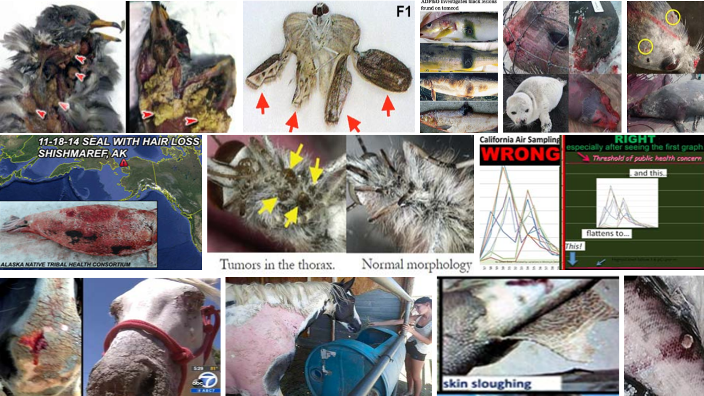
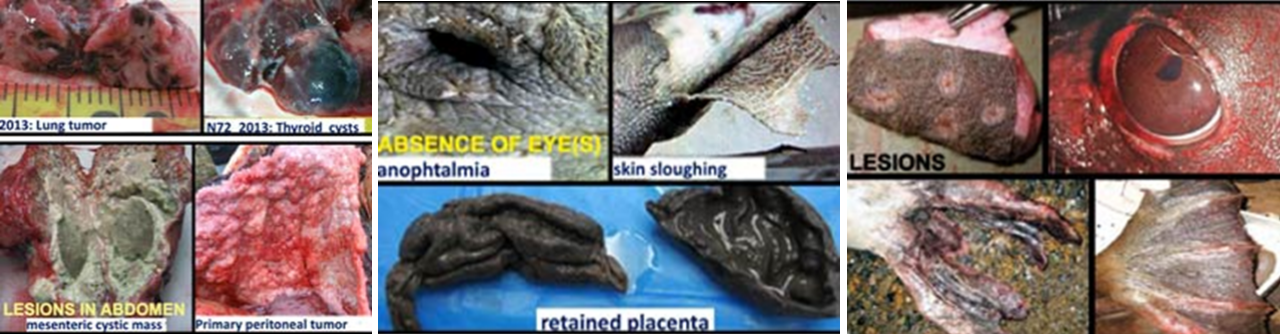
[Webmaster Note: Some of the photos surrounding this article are from the study, itself. Others may not be but are related and illustrative from the companion book database.]
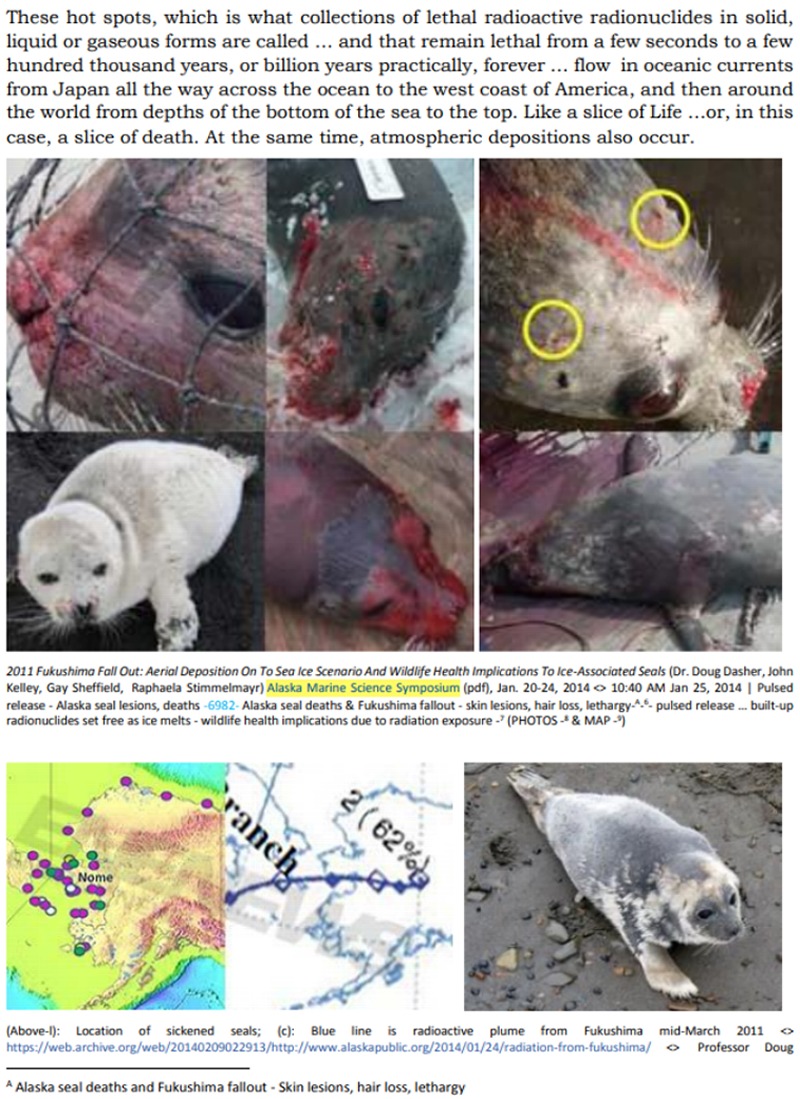
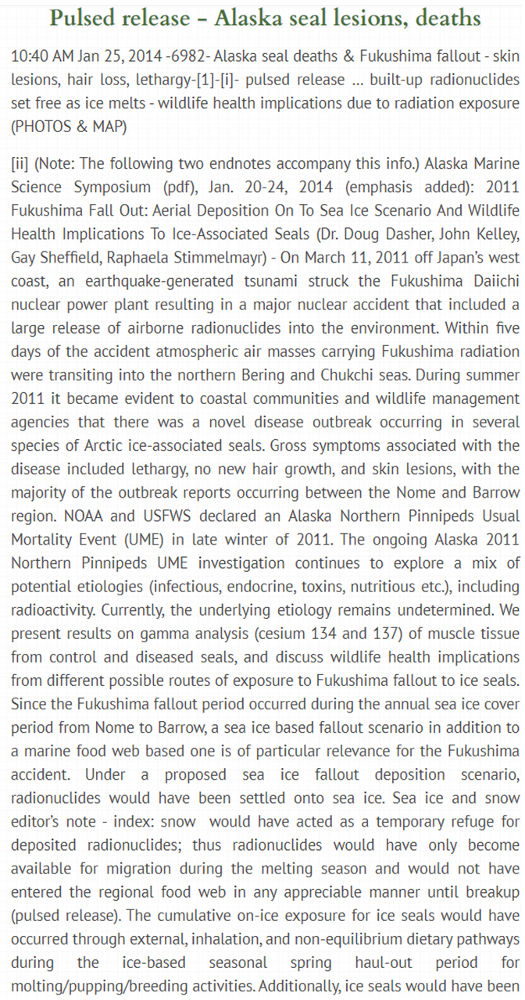
2011 Fukushima Fallout: Aerial Deposition on the Sea Ice (scenario) ...Wildlife Health Implications to Ice-Associated Seals
Doug Dasher, John J. Kelley, Gay Sheffield, Raphaela Stimmelmayr, University of Alaska Fairbanks, School of Fisheries and Ocean Sciences
Hot Particles Exposure Not Addressed
Conclusions: Tissue C134,137 concentrations and models suggest the 2011 fallout even does not reprepresent acute or chronic radiological risks to Northern Pinniped populations. Exposure to hot particles was not addressed. Cannot rule out that increased radiological exposure in combination with a mixture of other contaminants represented an immunotoxic and thyroid gland diseass risk during the period the animals were living on the ice. Ionizing radiation associated risk for skin defects (i.e. epilation, skin lessions) due to contact and external exposure can also not be excluded. Marine transported Fukushima radionucles entering the Bering and Chukchi Seas in the future may represent a new stressor to the ecosystem.
Lesions
Courtesy of Alaska Native Tribal Health Association
Seals suffering lesions
Hair loss and lesions
Hair loss , baldness and lesions
Hair loss, baldness, lesions
here is our listing
Over 50 dead seals, sea lions, whales, walrus recently stranded in Alaska — Dozens of seals suffering from baldness, skin sores — Experts: “Marine transported Fukushima radionuclides… may represent a new stressor to ecosystem”
Published: May 6th, 2014 at 10:12 pm ET 159 comments
Poster for Alaska Marine Science Symposium, Jan. 20, 2014: Based on modeled radionuclide concentrations the dose to Northern Pinnipeds on ice was less than the ERICA risk assessment no-effects level of 10 uGy/hr with the following caveats: 1) Source terms for the Fukushima nuclear accident release vary greatly creating uncertainty in the models. 2) Knowledge gaps exist on extrapolating radiation dose to marine mammals. 3) Exposure to hot particles was not addressed. 4) Cannot rule out that increased radiological exposure in combination with a mixture of other contaminants represented an immunotoxic and thyroid disease risk during the period the animals were living on the ice. 5) Ionizing radiation associated risk for skin defects (i.e. epilation, skin lesions) due to contact and external exposure can also not be excluded. *Marine transported Fukushima radionuclides entering the Bering and Chukchi Seas in the future may represent a new stressor to the ecosystem.
Nome Nugget, Jan. 2 2014: Hunters still report hairless seals — A Nome subsistence hunter reported the harvest of an oogruk showing symptoms of the disease that broke out in 2011 and left hundreds of seals hairless or dead. The breakout of the disease is still under federal investigation as an “unusual mortality event”. Symptoms of the disease included bald seals, skin sores and apathy.
NOAA, Feb. 2014: [...] seals reported with abnormal hair growth and healing skin ulcers are likely survivors of the initial disease. Hunters may continue to see hairless seals during spring 2014 [...] no specific infectious disease agent or process has been identified. This may suggest that the underlying cause of this disease is most likely complex, involving a variety of factors. [...] Scientists are investigating the possibility that radiation could have been one of many factors [...]
Nome Nugget, Apr. 10, 2014: [Gay Sheffield, Univ. of Alaska] has so far counted nine whale strandings, 25 dead walrus strandings, two sea lions and 18 seals. She also still collected data on Unusual Mortality Event suspected seals, showing hair loss, skin sores and delayed molt. Of those, she counted 10 spotted seals, eight ringed and six bearded seals. [...] [Officials] heard and adopted a resolution [...] that “the potential for pollution events includes oil spills, cargo or fuel spills, novel disease, invasive species, radiation [...] contaminants which can impact wildlife and can potentially be transferred to consumers is of high concern.” The resolution demands [...] research be conducted in the context of human health [...]
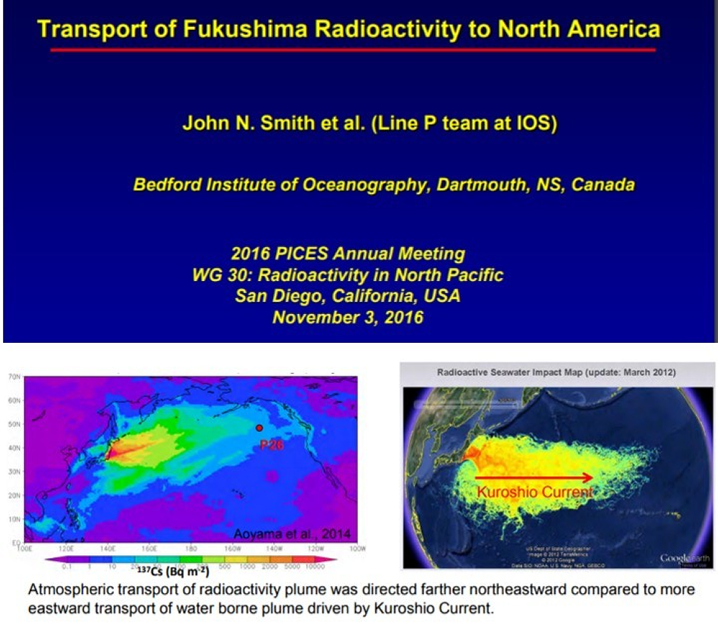
Transport of Fukushima Radioactivity to North America
John N. Smith et al. (Line P team at IOS). Bedford Institute of Oceanography, Dartmought, NS, Canada. 2016 PICES Annual Meeting, WG 30: Radioactivity in North Pacific; San Diego California, USA. November 3, 2016.
Transport of Fukushima Radioactivity to North America. John N. Smith et al. (Line P team at IOS). Bedford Institutute of Oceanography, Dartmought, NS, Canada. 2016 PICES Annual Meeting, WG 30: Radioactivity in North Pacific; San Diego California, USA. November 3, 2016. Chart addresses only CS 137 (Bq m2) Atmospheric transport of radioactivity plume was directed farther northeastward compared tomore eastward transport of water borne plume driver by Kuroshio (right). (Right) Kuroshio Current transport of Fukushima radioactive plume.
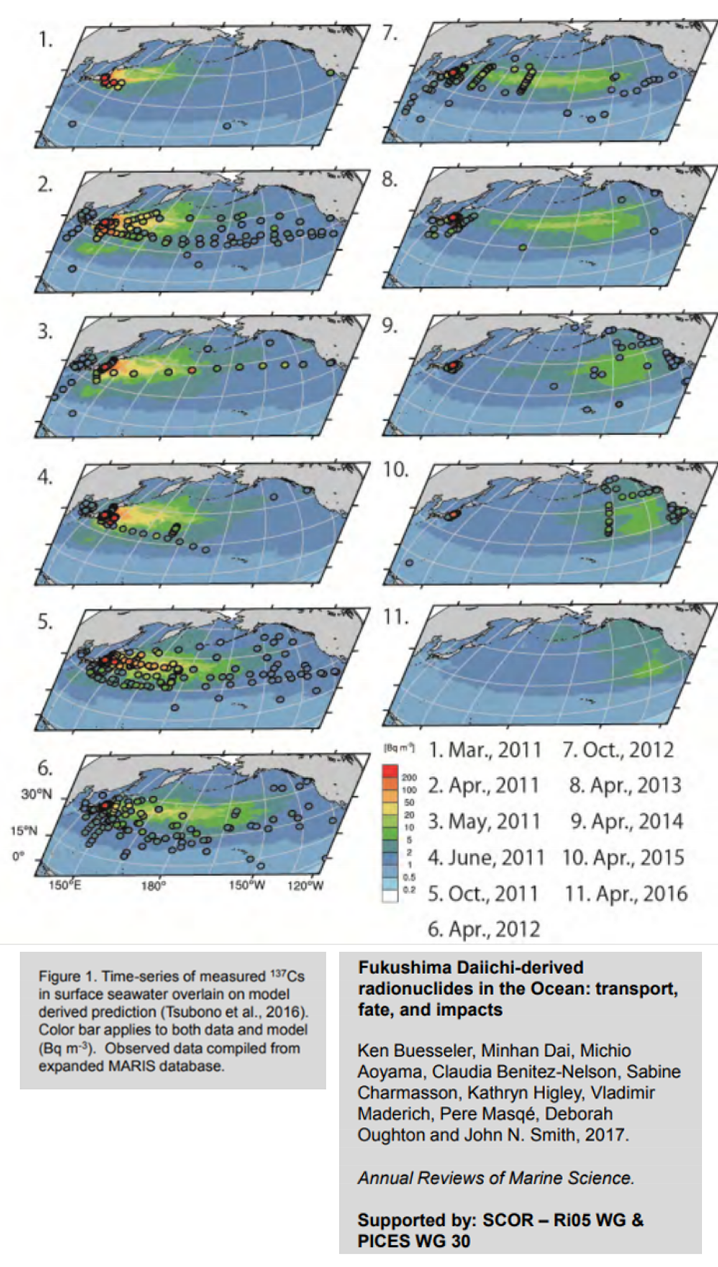
Time-series of measured Cs137 in surface seawater overlain on model derived prediction (Tsubono et al., 2016)
March, 2011-to-April, 2016: Time-series of measured Cs137 in surface seawater overlain on model derived prediction (Tsubono et al., 2016). Color bar applies to both data and model (Bq m3. Observed data compiled from expanded MARIS database. (right) Fukushima Daiichi-derived radionuclides in the Ocean: transport, fate, and impacts. Ken Buessleler, Minhan Dai, Michio Aoyama, Claudia Benitez-Nelson, Sabine Charmasson, Kathryn Higley, Vladimir Maderich, Pere Masqe, Deborah Oughton and John N. Smith, 2017. Annual Reviews of Marine Science.
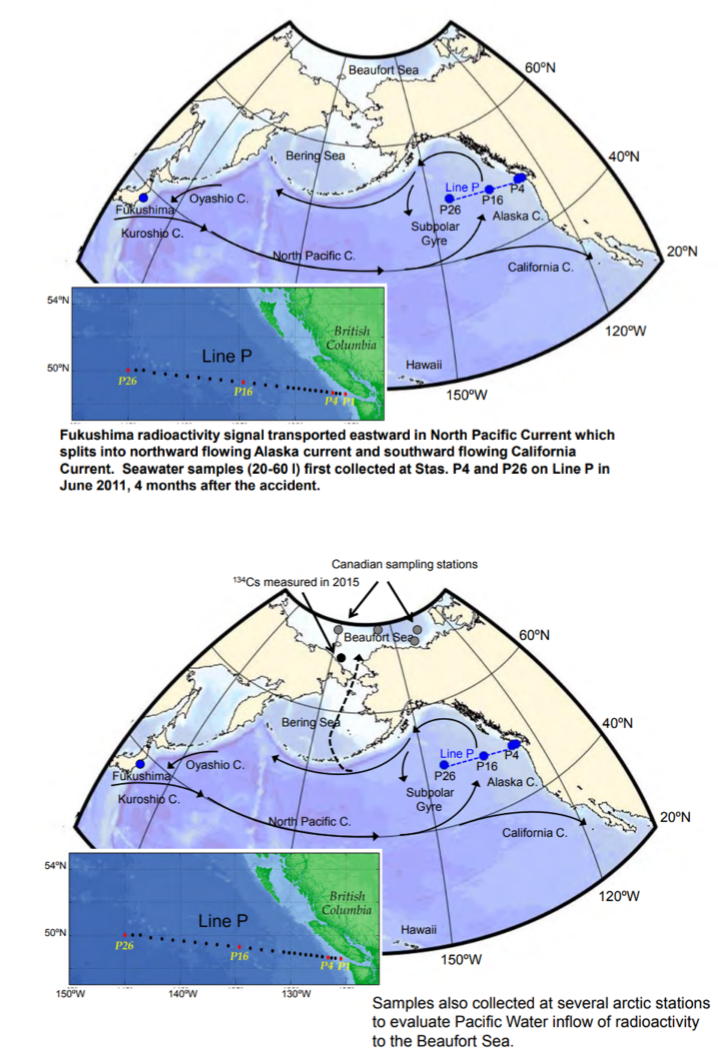
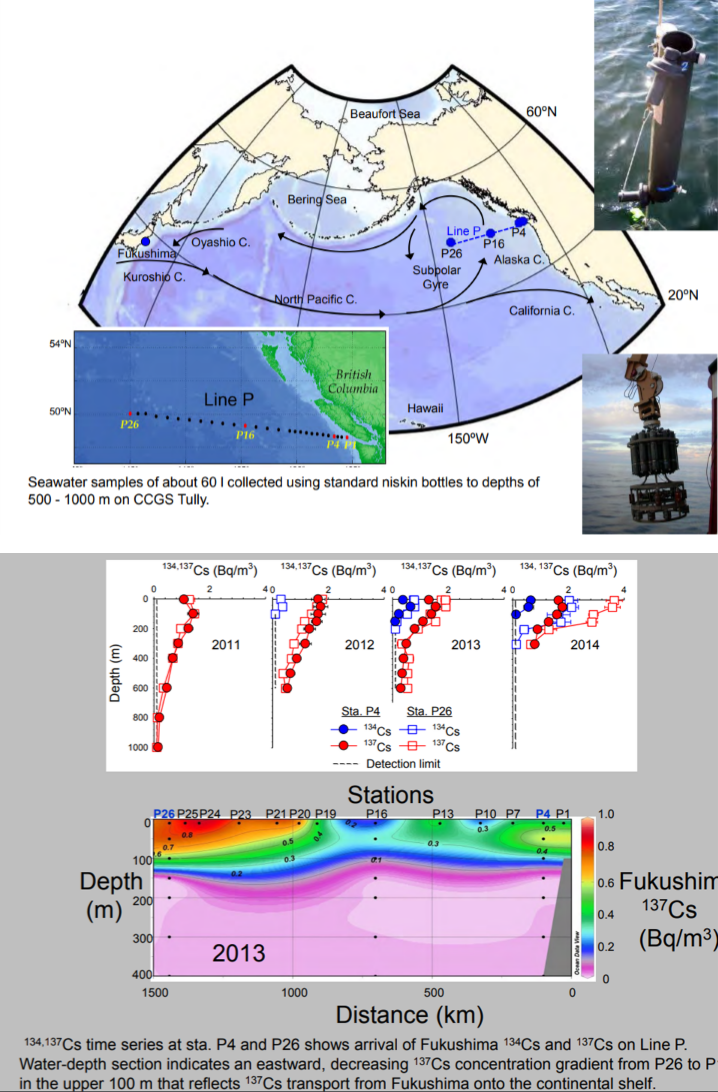
Canadian Sampling Stations
Canadian sampling stations Cs134 measured in 2015 ...Line P starts several hundred miles offshore and beelines to British Columbia, Canada.) Fukushima radioactvity signal transported eastward in North Pacific Current which splits into northward flowing Alaska current and southward flowing California Current. Seawater samples(20-60 l) first collected at Stations P4 on Line P in June 2011, 4 months after the accident. (bottom) Samples also collected at several arctic stations to evaluate Pacific Water inflow of radioactivity to the Beaufort Sea.
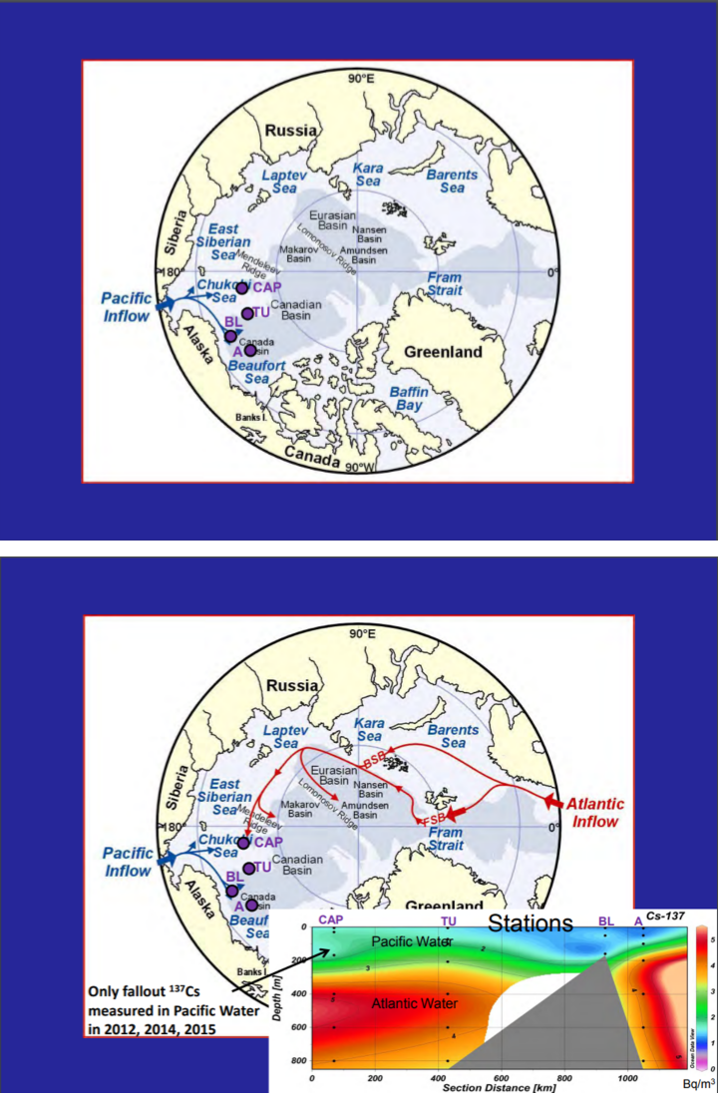
Pacific Inflow Alaska —> Greenland ...and... Sibera —> Russia
Pacific inflow between Alaska Chukoki Sea thru —> Canada Basin —> Beaufort Sea (Banks) —> Baffin Bay Greenland —> Fram Strait; ...and... Siberia Chukoki Sea —> East Siberia Sea —> Laptev Sea Russia —> Kara Sea —> Barents Sea.
Looking down on North Pole shows Pacific inflow flow of current between Alaska in the Chukoki Sea thru Canada Basin to Beaufort Sea (Banks) then Baffin Bay Greenland then Fram Strait; ...and... Siberia neighboring Alaska from the Chukoki Sea thru the East Siberia Sea, to the Laptev Sea Russia and Kara Sea and Barents Sea. (Color legend from cool to hot is ascending in 1-to-5 Bq/m3).
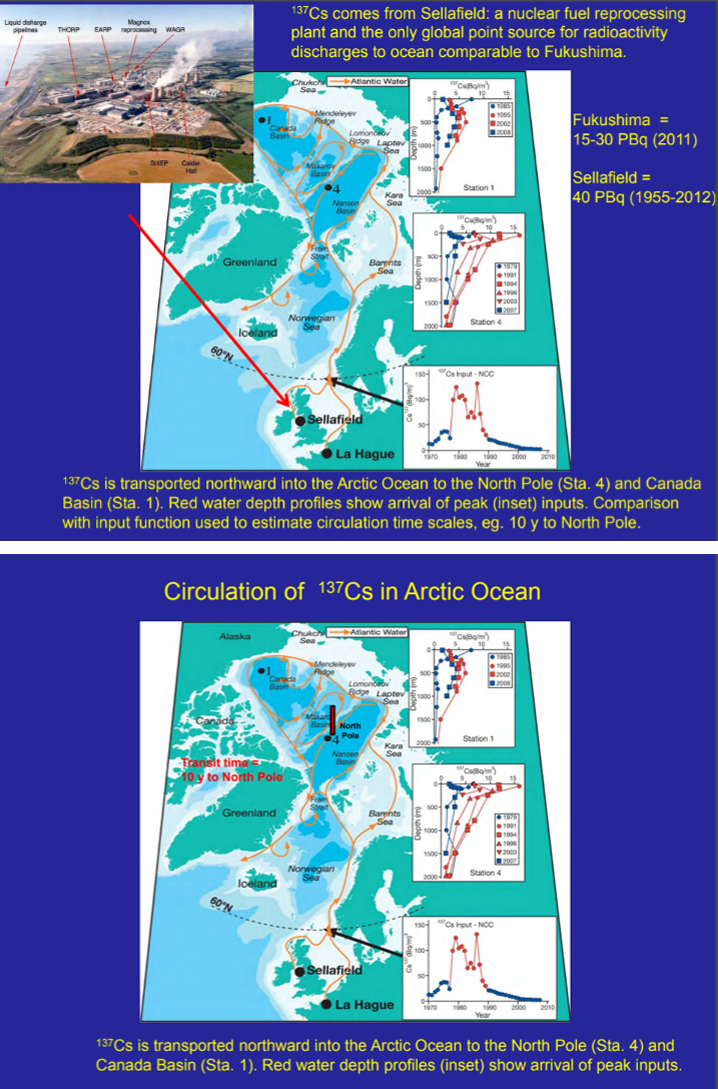
Sellafield and Fukushima Discharges of Ionizing Radiation as Global Distribution Points
CS137 is transported northward into the Arctic Ocean to the North Pole (Sta. 4) and Canada Basin (Sta. 1)
Cs137 comes from Sellafield: a nuclear fuel reprocessing plant and the only global point source for radioactivity discharges to ocean comparable to Fukushima. Fukushima = 15-30 PBq (2011. Sellafield = 40 PBq (1955-2012). CS137 is transported northward into the Arctic Ocean to the North Pole (Sta. 4) and Canada Basin (Sta. 1). Red water depth profiles show arrival of peak (inset) inputs. Comparison with input function used to estimate circulation time scales, eg. 10 yr to North Pole.
Seawater samples of about 60 l collected using standard niskin bottles to depths of 500-1,000 meters on CCGS Tully. Cs134, 137 times series at Stations P4 and P26 shows arrival of Fukushima Cs134 and Cs137 on Line P. Water-depth section indicates an eastward, decreasing Cs137 concentration gradient from P26 to P4 in the upper 100 m that reflects Cs137 transport from Fukushima onto the continental shelf.
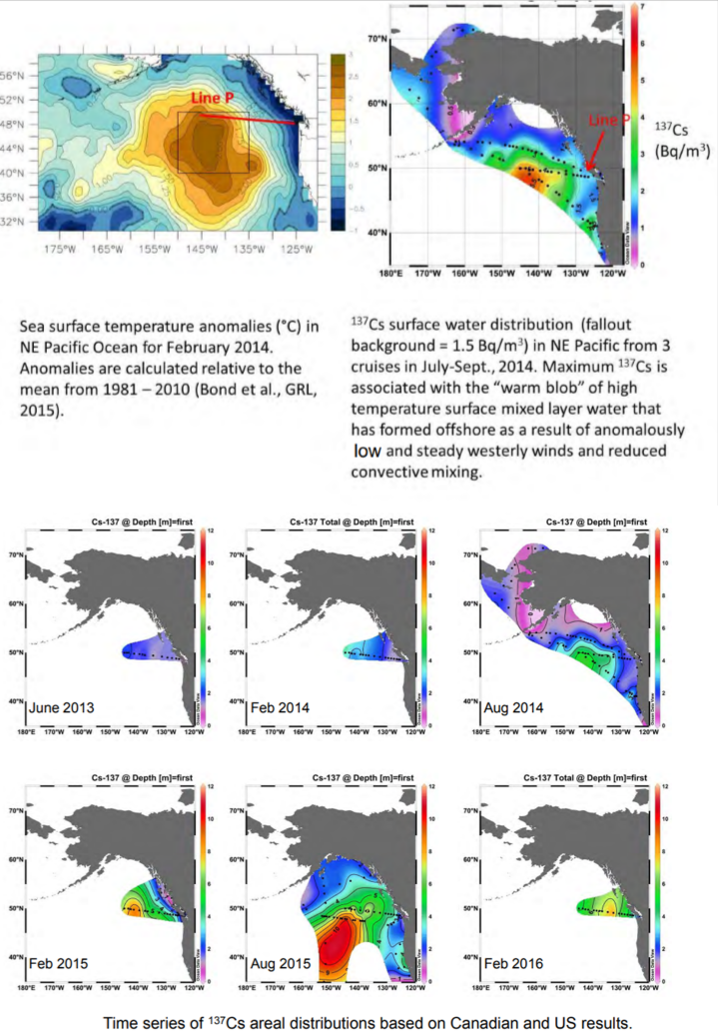
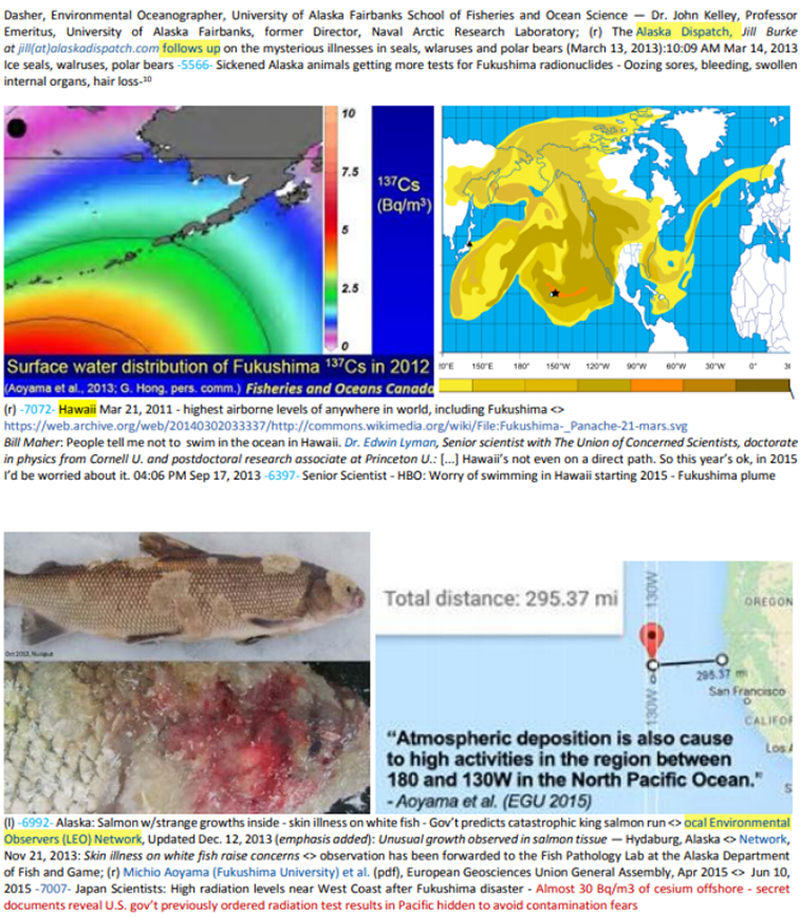
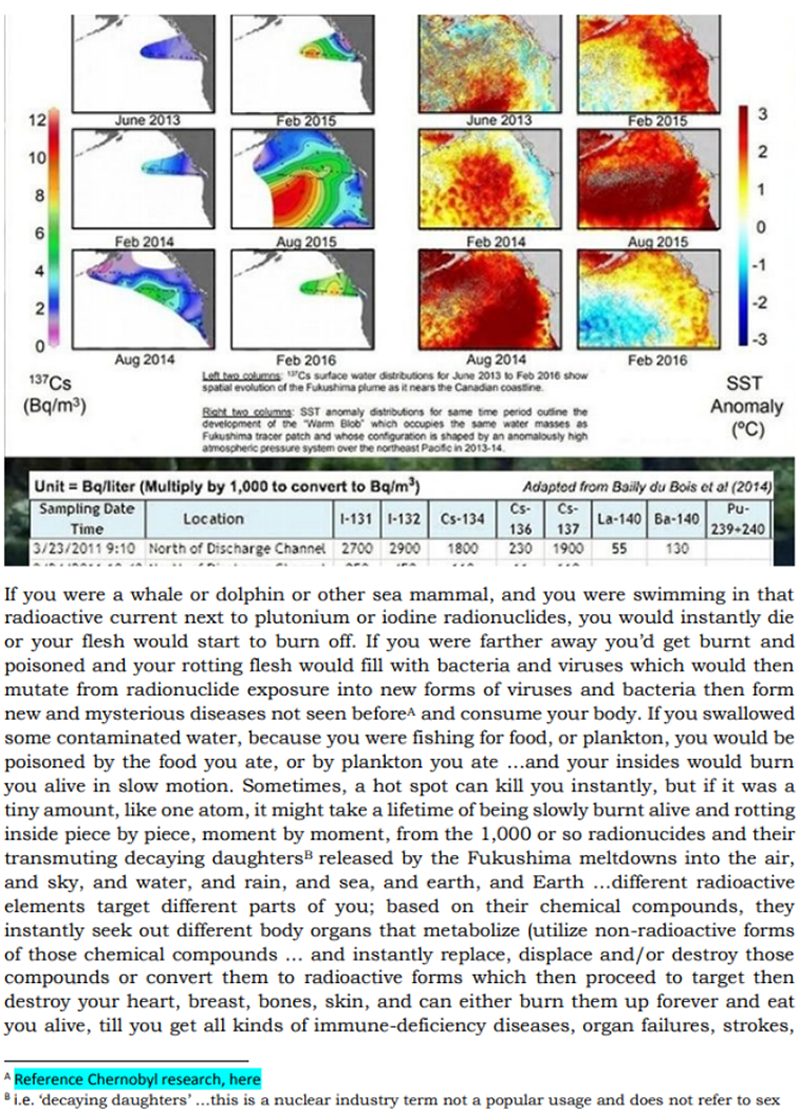
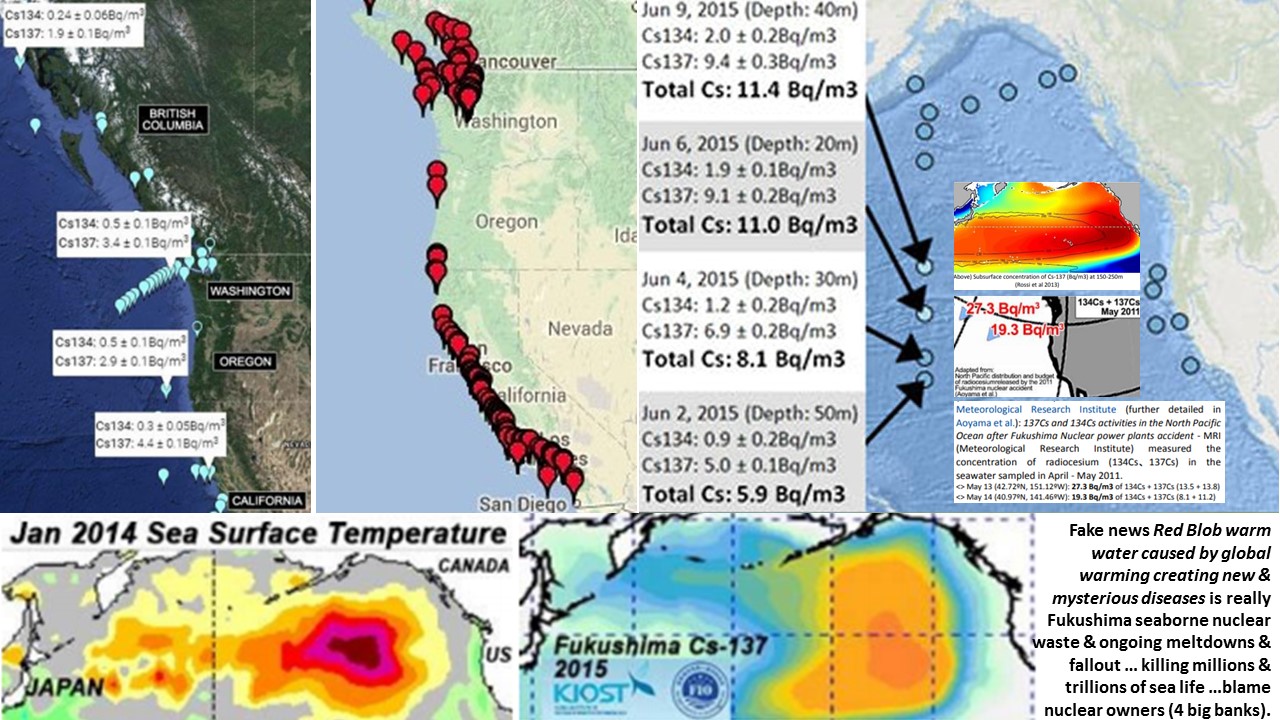
Sea surface temperature anomalies (0C) in NE Pacific Ocean for February 2014. Anomalies are calculated relative to the mean from 1981-2010 (Bond et al., GRL 2015). Cs137 surface water distribution (fallout background = 1.5 Bq/m3) in NE Pacific from 3 cruises in July-Sept., 2014. Maximum Cs137 is associated with the "warm blob" of high temperature surface mixed layer water that has formed offshore as a result of anomalously low and steady westerly winds and reduced convective mixing. Time series of Cs137 areal distributions are based on Canadian and U.S. results.
WARM BLOB CITED
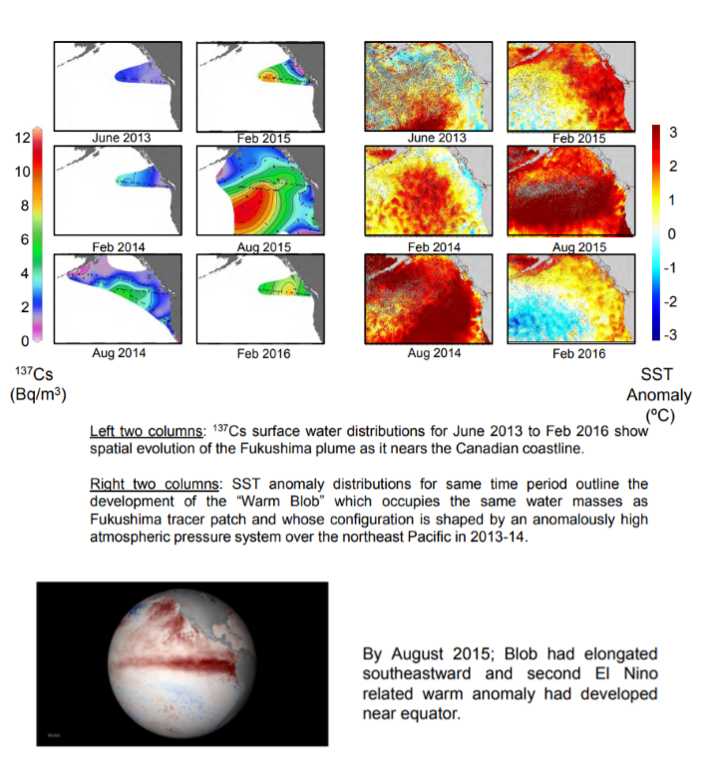
CS137 is transported northward into the Arctic Ocean to the North Pole (Sta. 4) and Canada Basin (Sta. 1)
c show spatial evolution of the Fukushima plume as it nears the Canadian coastline. SST anomaly distributions for same time period outline the development of the "Warm Blob" which occupies the same water masses as Fukushima tracer patch and whose configuration is shaped by an anomalously high atmosphereic pressure system over the northeast Pacific in 2013-14. By August 2015; Blob had elongated southeastward and second El Nin related war anomaly had developed near equator
WARM BLOB CITED
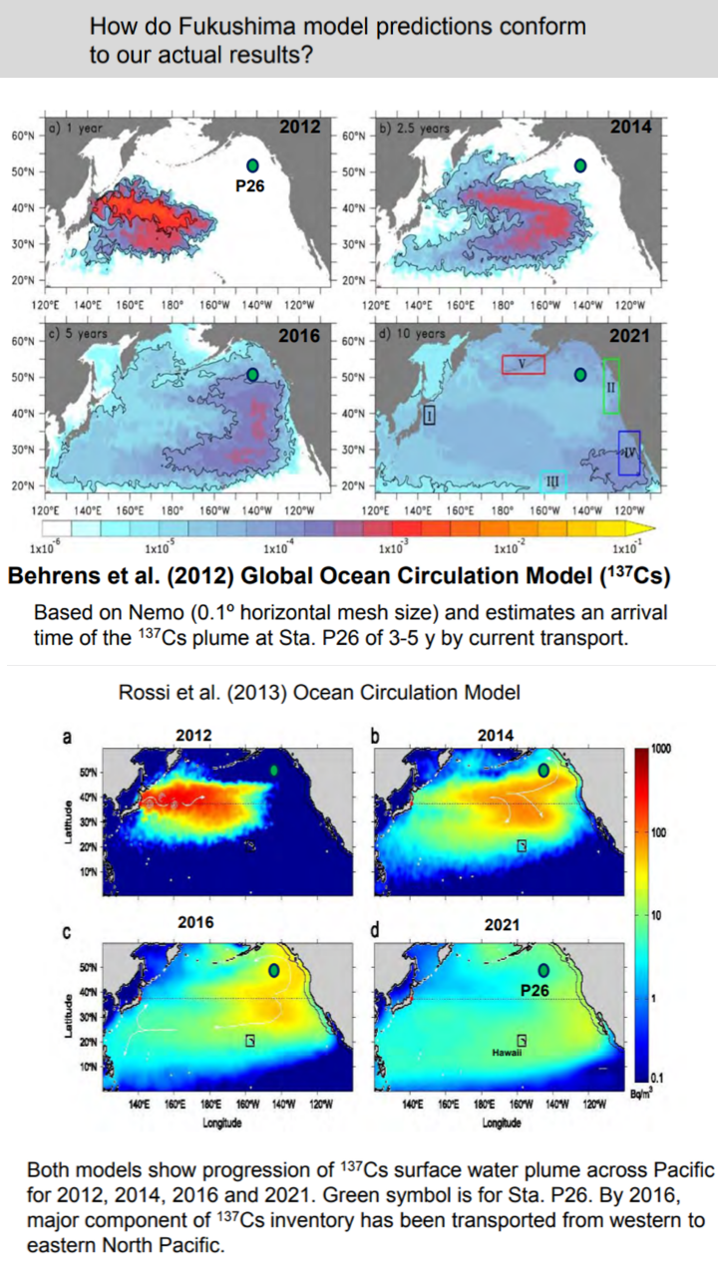
How do Fukushima model predictions conform to our actual results?
How do Fukushima model predicutions conform to [our] actual results? Behrens et al. (2012) Global Ocean Circulation Model (Cs137): Based on Nemo (0.1 horizontal mesh size) and estimates an arrival time of the Cs137 plume at Sta. P26 of 3-5 years by current transport. Rossi et al. (2013) Ocean Circulation Model [results compared]. Both models show progression of Cs137 surface water plume across Pacific for 2012, 2014, 2016 and 2021. [Green symbol is for Sta. P26.] By 2016, major component of Cs137 inventory has been transported from western to eastern North Pacific.
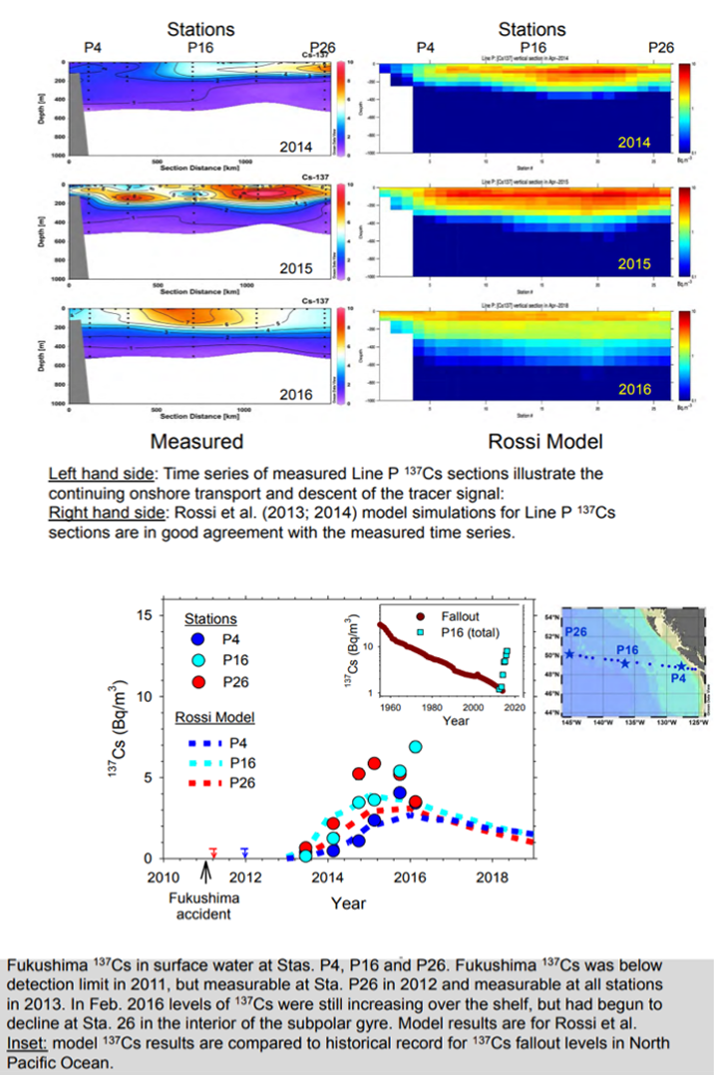
Measure: Time series of measured Line P Cs137 sections illustrate the continuing onshore transport and descent of the tracer signal: Rossi et al. (2013; 2014) model simulations for Line P Cs137 sections are in good agreement with the measured time series. Fukushima Cs137 in surface water at Stas. P4, P16 and P26. Fukushima Cs137 was below detection limit in 2011, but measurable at Sta. P26 in 2012 and measurable at Sta/ P26 at all stations in 2013. In Feb 2016, levels of Cs137 were still increasing over the shelf, but had begun to decline at Sta 26 in the interior of the subpolar gyre. Model results are for Rossi et al. Model Cs137 results are comared to historical record for Cs137 fallout levels in North Pacific Ocean.
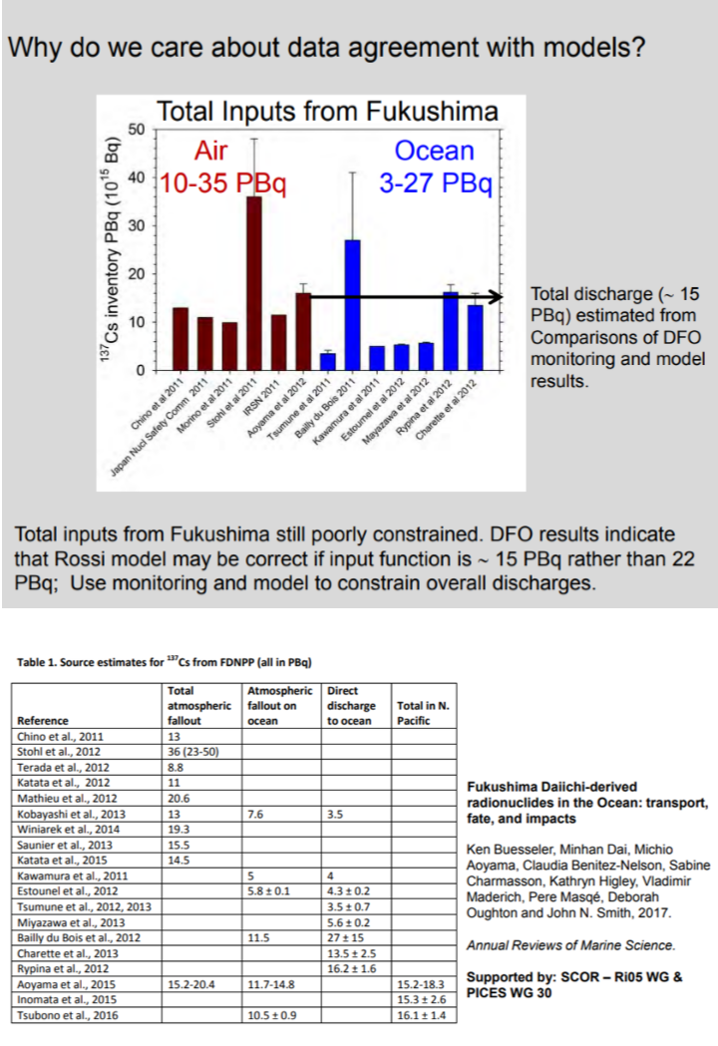
Why do we care about data agreement with models?
Total inputs from Fukushima still poorly constrained. DFO results indicate that Rossi model may be correct if input function is ~15 PBq rather than 22 PBq; use monitoring and model to constrain overall discharges. Total discharge (~15 PBq esstimated from comparisons of DFO monitoring and model results. Fukushima Daiici-derived radionuclides in the ocean: tansport, fate, and impacts: Annual Reviews of Marine Science. Source estimates for Cs137 frp, FDMPP (all in PBq).
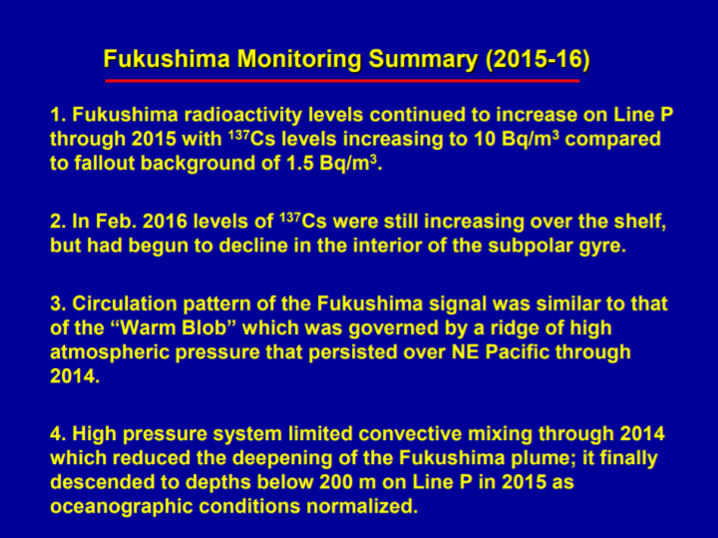
Fukushima Monitoring Summary (2015-2016)
(1) Fukushima radioactivity levels continued to increase on Line P through 2015 with Cs137 levels increasing to 10 Bq / m3 compared to fallout background of 1.5 Bq / m3. (2) In Feb. 2016 levels of Cs137 were still increasing over the shelf, but had begun to decline in the interior of the subpolar gyre. (3) Circulation pattern of the Fukushima signal was similar to that of the "Warm Blob" which was governed b a ridge of high atmospheric ressure that persisted over NE Pacific through 2014. (4) High pressure system limited convective mexing through 2014 which reduced the deepening of the Fukushima plume; it finally descended todepths beflow 200 m on Line P in 2015 as oceanographic conditions normalized.
WARM BLOB CITED
Marine Invertebrates (like Bottom-Dwelling Starfish & Sea Urchins) Proficient Absorbing Wide Range of Ingested Radioisotopes
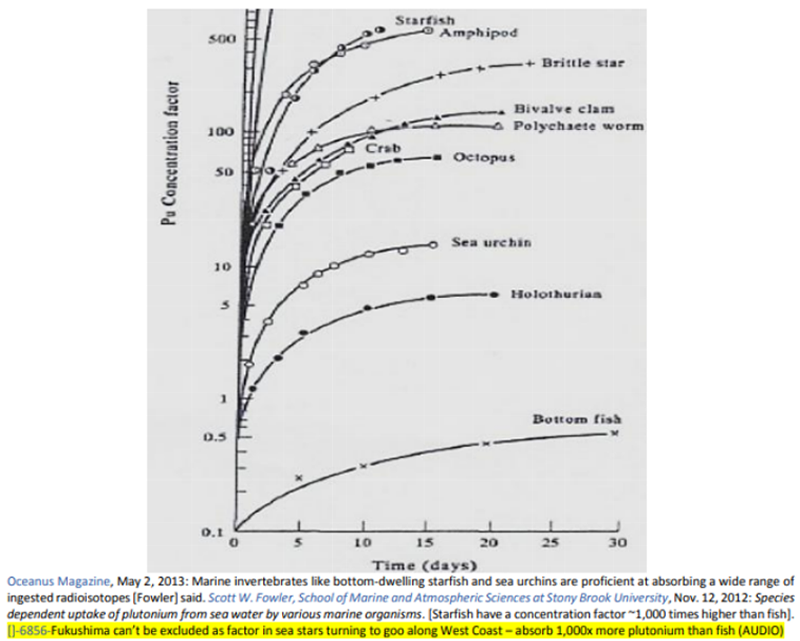
Species-dependent uptake of plutonium from sea water by various marine organisms (from least uptake to most uptake), including: Bottom Fish, Holorthuria (Sea Cucumbers), Sea Urchin, Octopus, Crab, Polychaete Worm, Bivalve Clam, Brittle Star, Amphipod, Starfish (Starfish have a concentation factor of ~1,000 times higher absorbtion of Plutonium than fish; Fukushima can't be excluded as a factor in sea starts turning to goo along the entire West Coast.
[Editor's note: the following 4-digit numbers in blue are links excepted from our database of 8,011 headline links. If one clicks on the main headline link, which in this case is 6856, the following 8 summary paragraphs from 8 different published documents are show, each with their own link to the respective original document or study. If you assume 3-to-4 such links on each of 8,011 headline links, simply multiply 3.5 x 8,011 to determine a proximate sum total of links in the database, which we describe as 25,000-to-35,000 since some summary pages have 3-to-12 links, such as this 6856.]
02:05 AM Dec 28, 2013 -6856- Fukushima can’t be excluded as factor in sea stars turning to goo along West Coast; hasn’t been ruled out - proficient at absorbing radioisotopes; 1,000x more plutonium than fish (AUDIO)
-6856- The Oregonian, Dec. 27, 2013: Starfish [...] are dying on the West Coast in big numbers, wasting away, losing arms and simply turning to mush [...] colonies of starfish quickly die and disintegrate into white goo. Deaths have been confirmed from Alaska to Southern California. [...] Pete Raimondi, chairman of UC Santa Cruz’s ecology and evolutionary biology department [...] doesn’t believe the die-off is connected to any toxins in Japanese tsunami debris or radiation from the Fukushima Daiichi nuclear disaster, but he said those sources haven’t been ruled out either.
-6856- Earthfiles, Dec. 20, 2013: Radioactivity [didn't] seem to be a problem from the damaged Fukushima nuclear power plants in Japan. The Washington State Health Department and other agencies tested West Coast fish and have so far not found elevated radiation levels. Further if Strontium-90 and Cesium-137 contamination was a factor, many other marine creatures would be dying, not only sea stars. [...]
-6856- More on the radiation ‘tests’ by the State of Washington:
-6856- The Olympian, Nov. 24, 2013 (emphasis added): The [Washington] Health Department has test [sic] albacore tuna caught in the waters off the Pacific coast, one from before the Fukushima disaster and one caught after. In addition, the department has tested one salmon, one steelhead, as well as razor clams and other shellfish after the Fukushima disaster. [...] The problem with extrapolating radioactive contamination of fish to sea stars:
-6856- Oceanus Magazine, May 2, 2013: Marine invertebrates, such as bottom-dwelling starfish and sea urchins, are particularly proficient at absorbing a wide range of ingested radioisotopes [Fowler] said.
-6856- Heal the Bay: This year’s epidemic began in Washington in June; since then at least 12 different species of sea stars and even some purple sea urchins have been found as victims of the wasting disease. [...] [Sea stars are the] top predator from intertidal ecosystems [...]
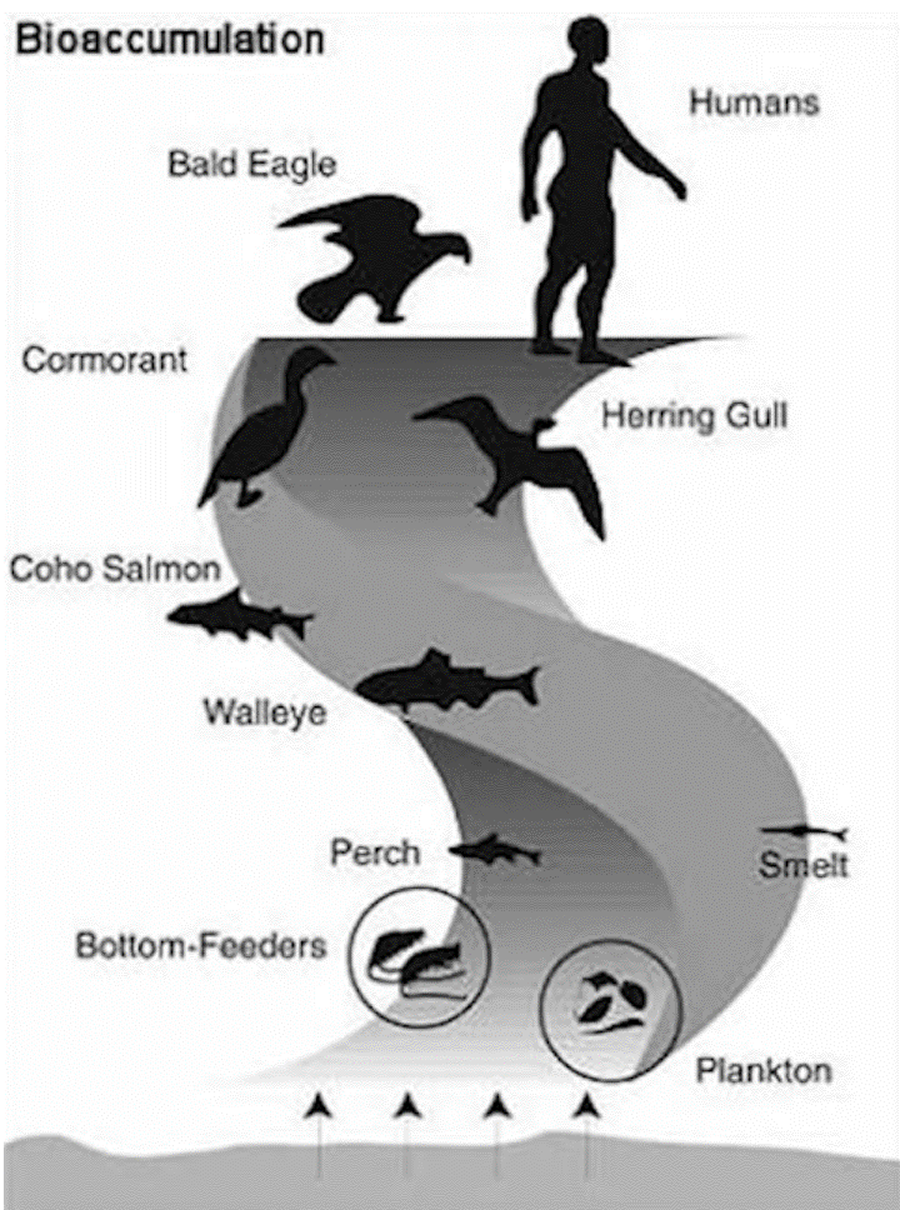
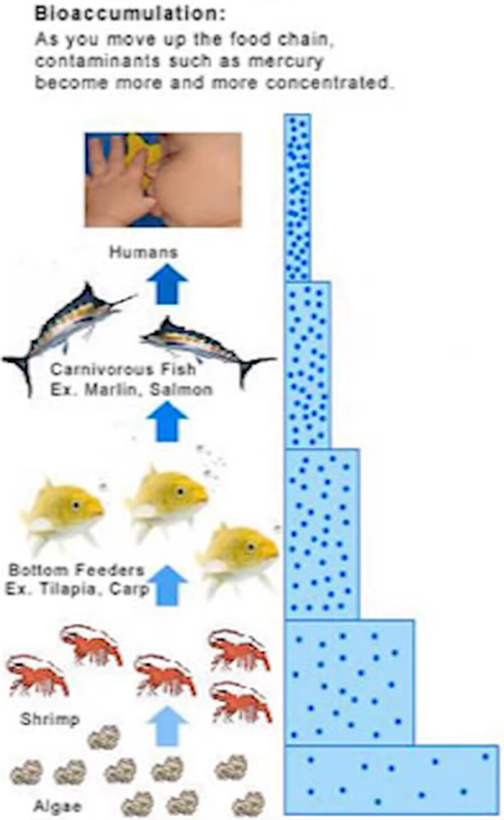
(cont) Metal and radionuclides bioaccumulation in marine organisms, October 2002: “Biomagnification” of metals and radionuclides in aquatic organisms refers to an increase in tissue concentration of a given element in higher [...] levels of a specific food chain.
(cont) WAMC Radio, Dec. 4, 2013: “The absence or decline of a single species can alert us to a problem that deserves closer attention.”
May 2, 2013 Oceanus Magazine - Marine invertebrates, such as bottom-dwelling starfish and sea urchins, are particularly proficient at absorbing a wide range of ingested radioisotopes [Fowler] said, (here).
[Editor's note: It appears that the discovery and publication of the information about the underground spring and the meltdowns into the water aquifers below, that flow into the Pacific Ocean is dated Apr 6, 2014 ...a year after the article by David Pacchioli was originally published, on May 2, 2013. Which emphasizes the persistance and brilliance of the researchers cited in both articles. ... ... ...However, it is significant to note that information regarding the meltdowns, Mox fuel and other words were forbidden by the Japanese State to be used by reporters and investigative journalists, and violations were considered high treason against the opinions of the Japanese government, and punishable by arrest and imprisonment ...which is to say information relevant to the Fukushima Daichi nuclear catastrophe was then and today remains highly restricted and withheld in Japan, and around the world. Similarly, doctors were not allowed to diagnose people with radiation sickness or to attribute any illness to the widespread nuclear fallout. This is covered elsewhere, (here).]
10:46 PM Apr 6, 2014 -8149- Marine Chemist: Highly contaminated waste flowing in aquifer below Fukushima- Mag: Groundwater can erupt from seafloor offshore - Gov’t expert warned about radioactive substances springing up in Pacific (PHOTOS)
(excerpts, emphasis added) In one experiment measuring uptake of Americium, worms exposed to contaminated sediments took up significantly more of the radioisotope than clams did. But both worms and clams took up much more of the radioisotopes from Pacific sediments, which contain relatively high amounts of silica minerals, than they did from Atlantic sediments, which contain more carbon minerals.
Food is another pathway into marine organisms and “may be in some cases the most important factor in uptake,” Fowler said. Consumed radioisotopes are assimilated internally through the gut, potentially a far more efficient route than if they are absorbed externally from the environment. Marine invertebrates, such as bottom-dwelling starfish and sea urchins, are particularly proficient at absorbing a wide range of ingested radioisotopes, he said, but fortunately, they lose that incorporated radioactivity over time, via excretion.
What’s puzzling to Fisher, Buesseler, and many other scientists is the persistence of these low but significant levels of radioactivity in the ocean. Jota Kanda, an oceanographer at the Tokyo University of Marine Science and Technology, has extensively studied coastal waters off Fukushima and calculated the amount of cesium still present in coastal waters shallower than 200 meters (660 feet) and in sediments on the seafloor. By his reckoning, what remains is less than three percent of the total discharge, with the rest long since flushed out to the open ocean.
Yet levels of the cesium radioisotopes are still being measured at several tens to hundreds of becquerels per cubic meter in this area, Kanda noted, considerably higher than the levels prior to the Fukushima disaster. More importantly, levels measured in coastal sediments and in some species of fish are higher than those in the surrounding water.
As Kanda sees it, there are three sources responsible for this stubborn presence. One is river runoff — the fallout washed by rainfall into nearby rivers that drain to the sea. He also suggested that a small amount of contaminated water from basement compartments in the reaction unit housing is continuing to leak from the plant itself. But the biggest culprit —the only plausible explanation for the steady levels of radioactive cesium being measured in fish tissue— is continuous input through a food source. And that, he said, points to sediments.
Kanda has estimated that a total of 95 terabecquerels of cesium (1012 becquerels) is present in coastal sediments. The question, he maintained, is how it got there. It could have drifted down to the seafloor in the fecal pellets of plankton that consumed it at the surface — and in fact, plankton in shallow waters sometimes showed elevated levels of cesium. It could also be arriving with organic bits and pieces carried along by river water. It could have adhered to clay particles that came in contact with contaminated water; such radioactive cesium is tightly bound to clay particles and may not be easily transferred to marine life.
Sediment is complex stuff, he explained. Viewed up close, a single grain of what looks like sand is likely a mélange of mineral, organic matter, and pore water—the liquid trapped in the tiny gaps between particles. How contaminants are taken into these agglomerations is not well understood. Echoing Scott Fowler, Kanda noted that the composition and properties of sediments can vary dramatically.
Solving the mystery of the ongoing radioactivity will require a thorough analysis of the seafloor off Fukushima’s coast, he stressed. “Local communities are concerned. They want to know ‘When can we resume fishing?’ We scientists will have to answer this question.”
The key may be how long cesium stays put and the pathways for its uptake into the food chain. Given the 30-year half-life of Cesium137, the sediments could be a possible source of contamination in the food chain for decades to come.
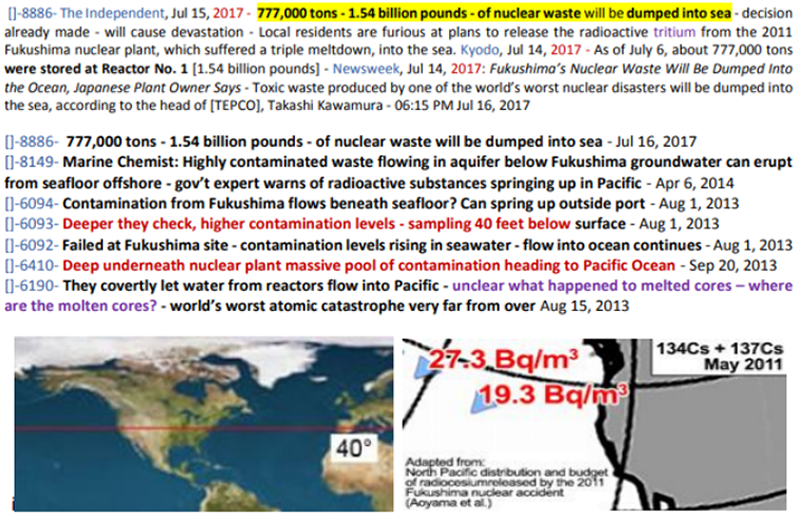
06:15 PM Jul 16, 2017-8886- 1.54 billion pounds ... 777,000 tons ... of nuclear waste will be dumped into sea - Official: decision already made – solution: pour radioactive liquid into ocean - will cause devastation
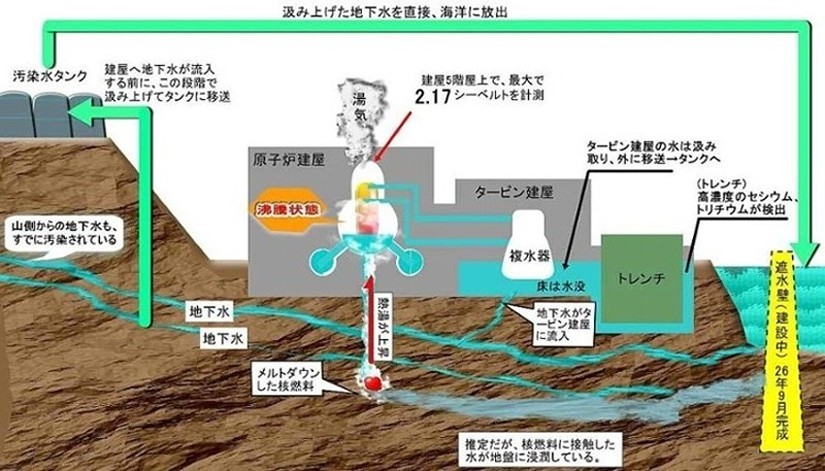
(above) 09:11 AM Jan 20, 2014 -6945- Image published by embassy in Japan shows Fukushima melted fuel deep underground (GRAPHIC) [Editor: As I recall, the fuel meltdown was 600 tons of melting lava reactor core & fuel rods.]
Image published by embassy in Japan shows Fukushima melted fuel deep underground
On July 22, TEPCO (Toyko Electric Power Company) announced it believes radioactive contaminated groundwater was leaking into the ocean because the water level fluctuation of contaminated groundwater in obervation holes was seen to be linked with the tidal level. Radioactive substances had been detected in the groundwater at observation holes as early as May. TEPCO began taking countermeasures to prevent these waters from flowing into the ocean in late June: (a) Injection of chemicals (liquid glass) into the ground to create impermeable wall-like structures; (b) Cleaning and sealing trenches; (c) Construction of impereable wall on the ocean side. Longer term plans being considered, include: (d) Installation of impervious wall ont he land side using soil freezing method; (e) Pumping up groundwater on the mountainside and discharging it to the ocean, creating a sort of a bypass. However, these measures have faced criticisms. For example, in the case of measure (a), such walls could not be created near the ground surface, and this raised concerns groundwater could go over them and reach the ocean. The effectiveness of plan (d) has also been questioned by civil engineers.
(below) 10:46 PM Apr 6, 2014 -8149- Marine Chemist: Highly contaminated waste flowing in aquifer below Fukushima- Mag: Groundwater can erupt from seafloor offshore - Gov’t expert warned about radioactive substances springing up in Pacific (PHOTOS)
Highly Contaminated Radioactive Waste Flowing in Aquifers below Fukushima Reactors
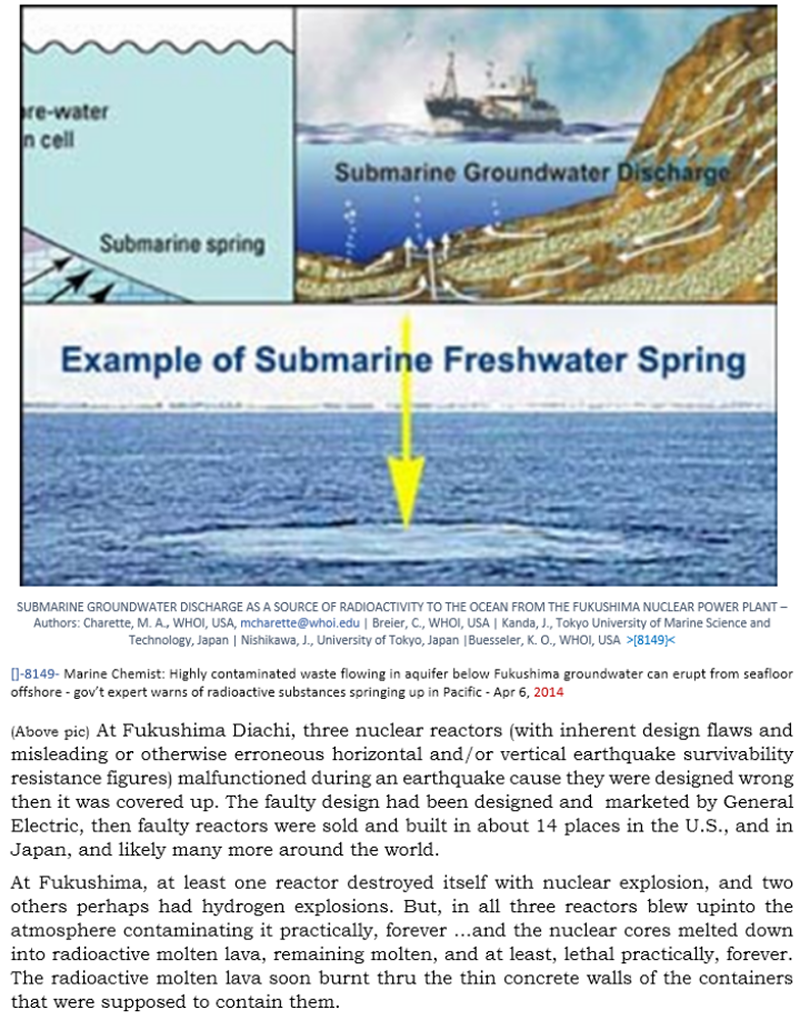
Ocean Sciences Meeting, Woods Hole marine chemist Matt Charette, Feb. 24, 2014: Submarine groundwater discharge as a source of radioactivity to the ocean from the Fukushima Nuclear Power Plant – [Cs-134, -137] have remained elevated over ~two years and exceed background values in the coastal ocean off Japan. [...] groundwater is infiltrating the NPP reactor buildings at several hundred tons/day and being transformed into highly contaminated radioactive wastewater [...] TEPCO has acknowledged ongoing direct radionuclide inputs to the local aquifer with the potential for transport to the coastal ocean via submarine groundwater discharge (SGD). We present results from a May 2013 survey [...] key radionuclides of concern (Cs isotopes, 90-Sr) will be presented [...]
Oceanus Magazine, published by Woods Hole Oceanographic Institution, Nov. 2004:
Contaminants may be introduced into groundwater [...] flow underground toward ocean [and] can influence [sea life] abundance. Groundwater often flows for long distances. Submarine groundwater discharge [will] often carry a substantial amount of [...] pollutants. Water at the bottom of the ocean — [Scientists try to determine] where groundwater is entering the sea, how much is flowing out, and how fast. Infrared cameras on planes [...] detect thermal contrast and see where groundwater is discharging. [Radioactive] radium and radon [are] useful indicators of groundwater discharge [since] they are not cycled or decayed as much as they would be in exposed seawater. Automated seepage meters [...] allow researchers to track flow of groundwater continuously [and] obtain high-resolution, long-term records of submarine groundwater discharge. NSF, WHOI, Cove Point Foundation, and NOAA provide funding for this research.
Following Narrative by Portland Homeboy is based on his two volume companion e-book series (here) & (here)
(Editor's note, for complete documentation, refer to the 8,011 links to 8,011 one-page summaries of 3-to-5 related articles that together link to 25,000-to-35,000 articles of published information and scientific studies included to serve as documentation. The MS Word version has a search engine; not sure if your PDF reader offers a search engine.)
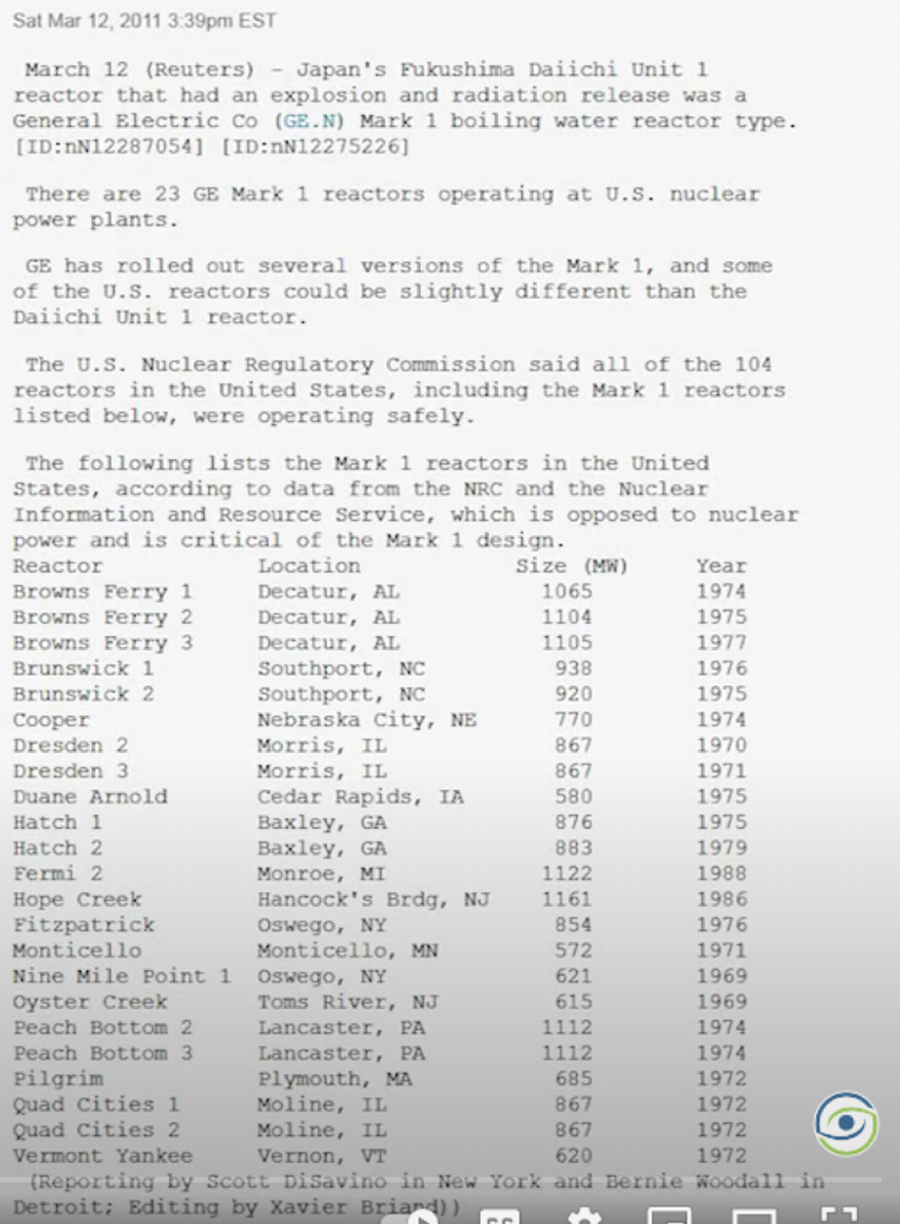
(below) At Fukushima Diachi, three nuclear reactors (with inherent design flaws and misleading or otherwise erroneous horizontal and/or vertical earthquake survivability resistance figures) malfunctioned during an earthquake because they were designed incorrectly then it was covered up. The faulty design had been designed and marketed by General Electric, and faulty reactors were sold and built in about 14 places in the U.S., and in Japan, and likely many more around the world.
At Fukushima, one reactor destroyed itself with a nuclear explosion, two others perhaps had hydrogen explosions.
At Fukushima, at least one reactor destroyed itself with a nuclear explosion, and two others perhaps had hydrogen explosions. But, in all three, reactors blew up into the atmosphere contaminating it practically, forever ...and the nuclear cores melted down into radiocactive molten lava, remaining molten; they will remain lethal practically, forever. The radioactive molten lava soon burnt thru the thin concrete walls of the containers that were supposed to contain the lava.
Then, the molten lava radioactive cores — which will remain radioactive and lethal for about 250,000 years or so, burnt down thru the Earth far below beneath the reactors, into underground rivers (called aquifers) flowing from the mountains to the sea. The aquifers came down from the mountins, ran underneath the nuclear reactors, then continue running out into the Pacific Ocean.
Since March 2011, hundreds of tons of water every day pass by the radioactive lava cores.
Since March of 2011 (3/11–Fukushima, not 9/11-WTC), hundreds of tons of water every day pass by the radioactive lava cores. They poison the water with radionuclides, and the water, now carrying hundreds and thousands of tons of radioactive materials every day ...and itself, immediately becoming radioactive 24/7/365, all flows underground under the seabed of the Pacific Ocean. Then it bubbles up into the ocean, up to the surface. When the water travels underneath the floor of the ocean then bubbles out from underground, out into the sea, coming up in it from underground, out into the the sea, coming up from sub-marine (under the water) freshwater springs and rises to the surface of the ocean, it carries radionucles in solid, liquid and gas form.
These forms can vary, some are more lethal than others, and some kill you faster, and some kill you slower. These lethal accumulations can be referred to as a 'hot spot'. Some hot spots kill you faster, some kill you slower. They all destroy you and your body's immune system, some instantly ...cause you're melted and fried, some slower, gifting you hundreds of immune deficiency diseases and cancers and leukemias of the eye, and brain, and breast, and prostate, and skin, and bones, and other organs ... some just rot your body slowly, over a period up to 30 years to manifest, and some destory your heart, for example, upon contact, or otherwise weaken it to destroy you over time and Time, again.
It doesn't matter how old, or how young you are, if you reside in your mother's womb, or ovum or father's sperm
And, it doesn't matter how old, or how young you are, or if you currently reside in your mother's womb, or her ovum or in your father's sperm. If nuclear industry radionuclides touch your life, or what will become of your life, you are instantly marked for malformation (mutation), disability, deformity, and up to hundreds of immune deficiency diseases leading to cancer and leukemia. If you, or any living thing such as a tuna, or salmon, or herring, or plankton, or whale, or dolphin, or seal, or turtle were next to this emerging radioactive spring of solid, liquid and gaseous radioactive water riotious with hot particles, you would instantly die.
These hot spots, which is what collections of lethal radioactive radionucldes in solid, liquid or gaseous forms are called (that is, collections of hot particles) ...and that remain lethal from a few seconds to a few hundred thousand years, or billion years practically, forever ... flow in oceanic currents from Japan all the way across the ocean to the west coast of America, and then around the world from depths of the bottom of the sea to the top. Like a slice of Life ...or, in this case, a slice of death. At the same time, atmospheric depositions also occur.
If you were a whale or dolphin or other sea mammal swimmng & eating in radioactive currents with plutonium or iodine radionuclides, you would instantly die or your flesh start to burn off
If you were a whale or dolphin or other sea mammal, and you were swimmng and eating in that radioactive current of plutonium or iodine radionuclides, you would instantly die or your flesh would start to burn off. If you were farther away you'd get burnt and poisoned and your rotting flesh would fill with bacteria and viruses which would then mutate from radionuclide exposure into new forms of viruses and bacteria then form new and mysterious diseases not seen before and consume your body. If you swallowed some contaminated water, because you were fishing for food, or plankton, you would be poisoned by the food you ate, or by the plankton you ate ...and your insides would burn you alive in slow motion.
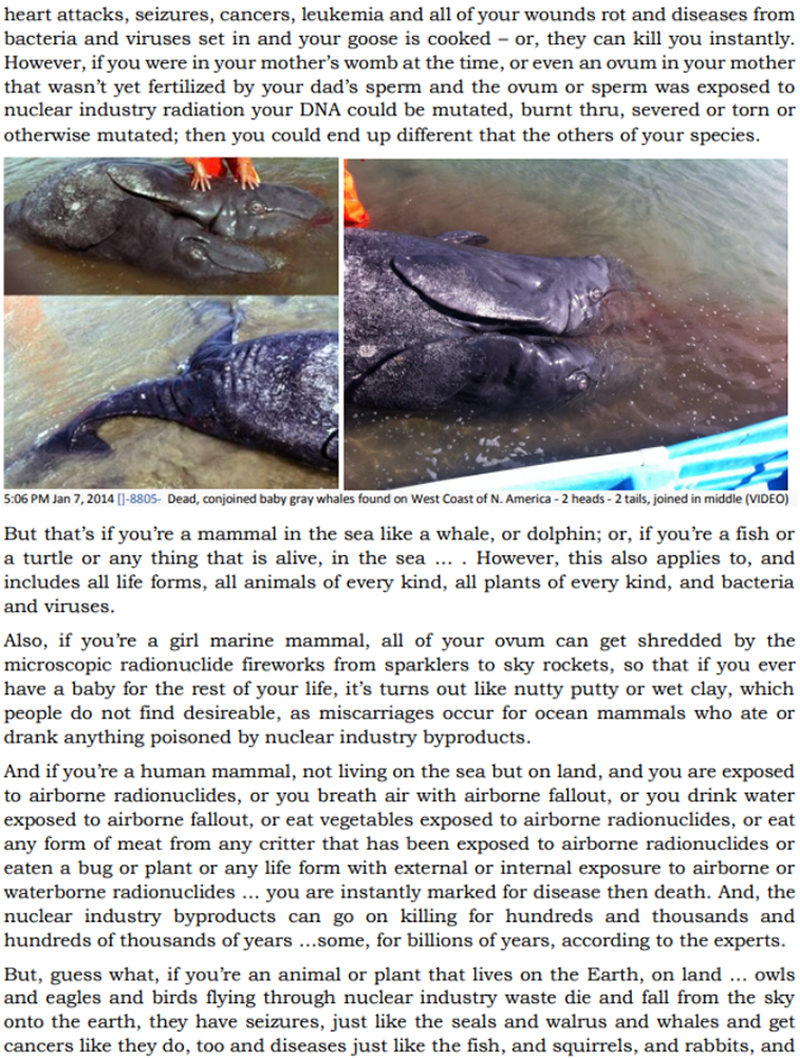
Sometimes, a hot spot can kill you instantly, but if it was a tiny amount, like one atom, it might take a lifetime of being slowly burnt alive and rotting inside piece by piece, moment by moment, from the 1,000 or so radionuclides and their transmuting decaying daughters released by the Fukushima meltdowns into the air, and sky, and water, and rain, and sea, and earth, and Earth ...different radioactive elements target different parts of you; based on their chemical compounds, they instantly seek out different body organs that metabolize (utilize) non-radioactive forms of those chemical compounds ...and instantly replace, displace and/or destroy those compounds or convert them to radioactive forms which then proceed to target then destroy your heart, breast, bones, skin, and can either burn them up forever and eat you alive, till you get all kinds of immune-deficiency diseaes, organ failures, strokes, heart attacks, seizures, cancers, leukemia and all of your wounds rot and diseases and viruses set in and your goose is cooked — or, they can kill you instantly. However, if you were in your mother's womb at the time, or even an ovum in your mother that was't yet fertilized by your dad's sperm and the ovum or sperm was exposed to nuclear industry radiation your DNA could be mutated, burnt thru, severed or torn or otherwise mutated; then you could end up different than the others of your species.
All life forms, all animals of every kind, all plants of every kind & bacteria & viruses
But that's if you're a mammal in the sea like a whale, or dolphin; or, if you're a fish or a turtle or any thing that is alive, in the sea ... . However, this also applies to, and includes all life forms, all animals of every kind, all plants of every kind, and bacteria and viruses.
If you're a girl marine mammal
Also, if you're a girl marine mammal, all your ovum can get shredded by the microscopic radionuclde fireworks from sparklers to sky rockets, so that if you even have a baby for the rest of yor life, it turns out like nutty putty or wet clay, which people do not find desireable, as miscarriages occur for ocean mammals who ate or drank anything poisoned by the nuclear industry byproducts.
If you're a human mammal
And, if you're a human mammal, not living in the sea but on land, and you are exposed to airborne radionuclides, or you breathe air with airborne fallout, or you drink water exposed to airborne fallout, or eat vegetables exposed to airborne radionuclides or eaten a bug or plant or any life form with external or internal exposure to airborne or waterborne radionuclides ... you are instantly marked for disease then death. And, the nuclear industry byproducts can go on killing for hundreds and thousands and hundreds of thousands of years ...some, for billions of years, according to the experts.
If you're an animal or plant that lives on the Earth
But, guess what, if you're an animal or plant that lives on the Earth, on land ... owls and eagles and birds flying through nuclear industry waste die and fall from the sky onto the earth, they have seizures, just like the seals and walrus and whales and get cancer like they do, too and diseases just like the fish, and squirrels, and rabbits, and dogs, and cats, and cows and horses ... and people, too. And trees, and hay, and eggs, and milk, and leafy vegetables, and non-leafy vegetables, and root crops.
Currently, there are insane men and women and straights, lesbians, bi-sexuals, trans-sexuals, queers and hermaphrodites (LGBTQ+) running the world who teach children and adults that nuclear energy is safe and clean.
Look at the animals that nuclear industry tortures and destroys, the people nuclear industry tortures and destroys ...you decide foryourself if nuclear is safe and clean
Scroll thru theses pages [of the two-volume companion book series and this website], look at the animals that nuclear industry tortures and destroys, the people nuclear industry tortures and destroys ...you decide foryourself if nuclear is safe and clean ...or, not. If it's not, then you will understand why all the sand and tortured life form in these e-books and website are visiting you, telling you, sharing and showing their story ...so you can help them...
...then, you have to decide what to do with the leaders of the nuclear industry, who have deceived you because they are as evil as evil can be .. they have known how dangerous nuclear is since they created it and /or had it created for them almost 100 years ago.
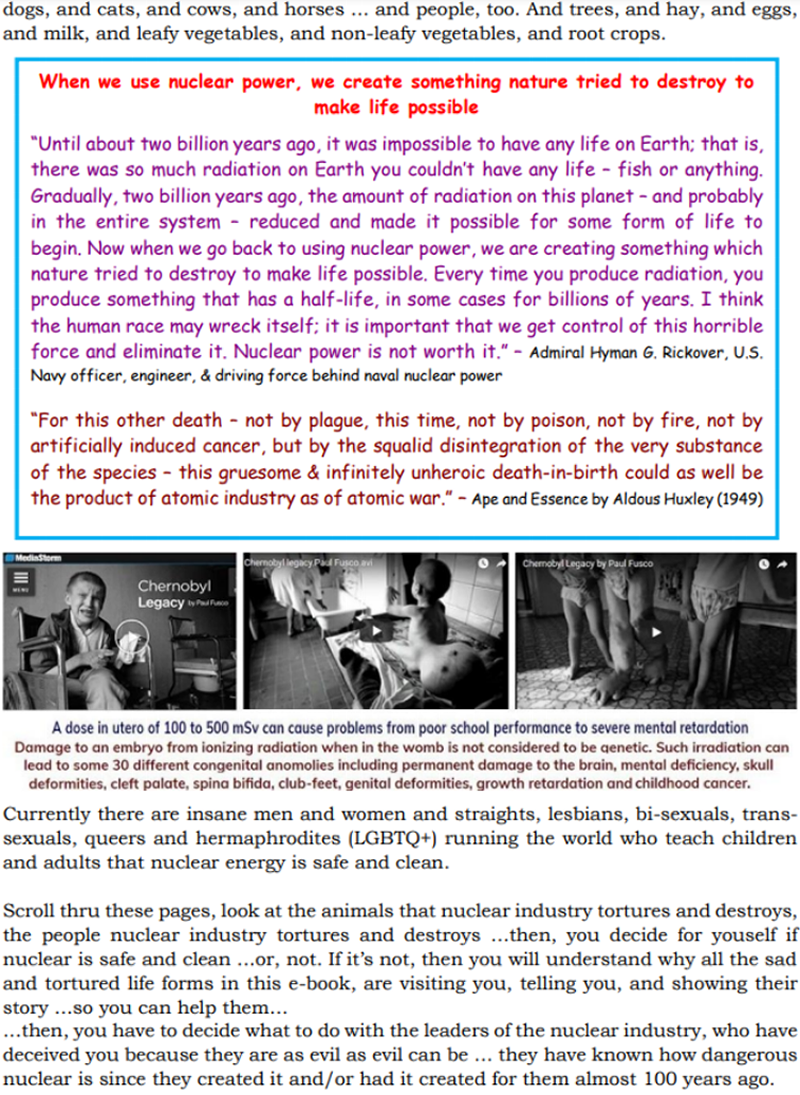
When we use nuclear power, we create something nature tried to destroy to make life possible
"Until about two billion years ago, it was impossible to have any life on Earth; that is, there was so much radiation on Earth you couldn't have any life — fish or anything. Gradually, two billion years ago, the amount of radiation on this planet — and probably in the entire system — reduced and made it possible for some form of life to begin. Now when we go back to using nuclear power, we are creating something which nature tried to destory to make life possible. Every time you produce radiation, you produce something that has a half-life, in some cases for billions of years. I think the human race may wreck itself; it is important that we get control of this horrible force and eliminate it. Nuclear power is not worth it." — ADMIRAL HYMAN G. RICKOVER, U.S. NAVY OFFICER, ENGINEER, AND DRIVING FORCE BEHIND NAVAL NUCLEAR POWER.
"For this other death — not by plague, this time, not by poison, not by fire, not by artificially induced cancer, but by tghe squalid disintegration of the very substance of the species — this gruesome and infinntely unheroic death-in-birth could as well be the product of atomic industry as of atomic war." — APE AND ESSENCE, BY ALDOUS HUXLEY (1949)
(above) Submarine groundwater discharge as a source of radioactivity to the ocean from the Fukushima Nuclear Power Plant — Authors: Charette, M.A., WHOI, USA, mcharette@whoi.edu | Breier, C., WHOI, USA | Kanda, J., Tokyo University of Marine Science and Technology, Japan | Nishikawa, J. University of Tokyo, Hapahn | Buesseler, K.O., WHOI, USA [see database entry 8149]
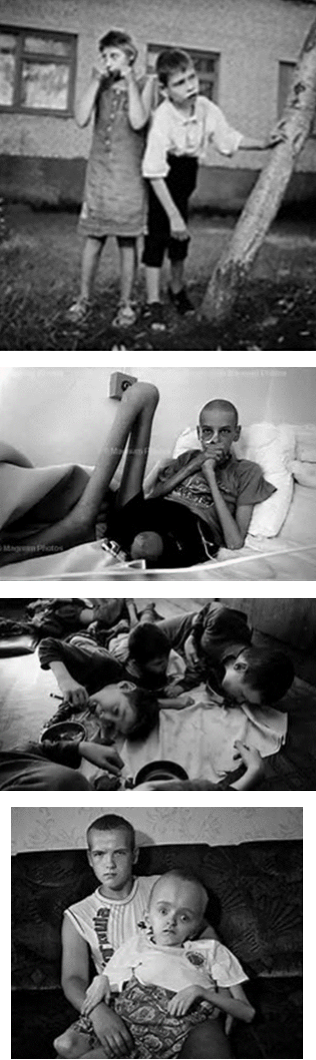
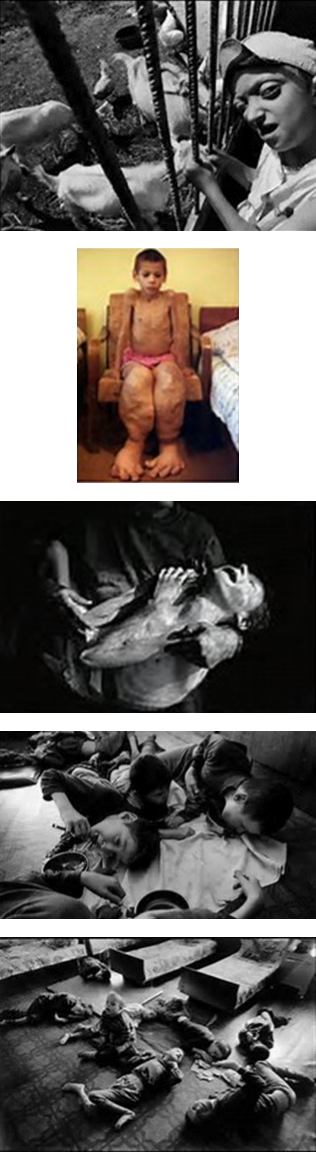
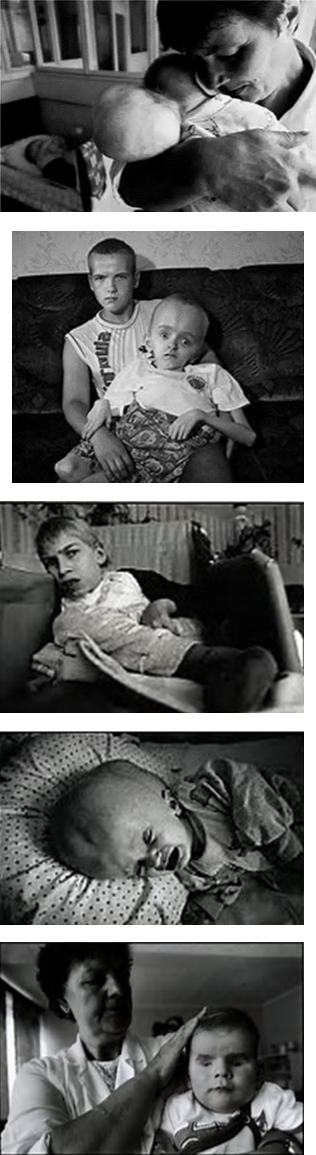
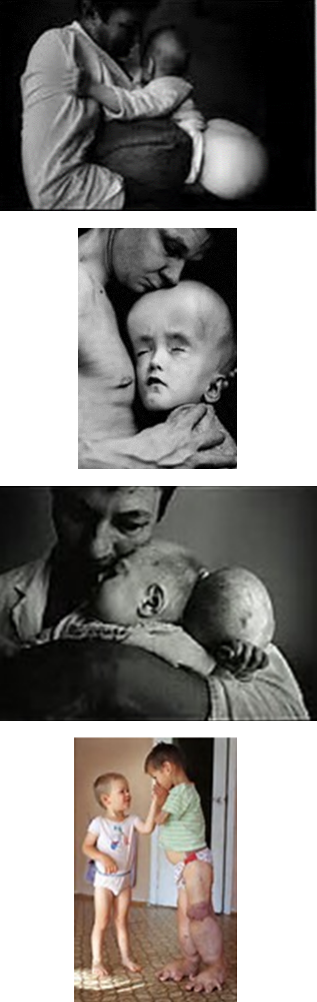
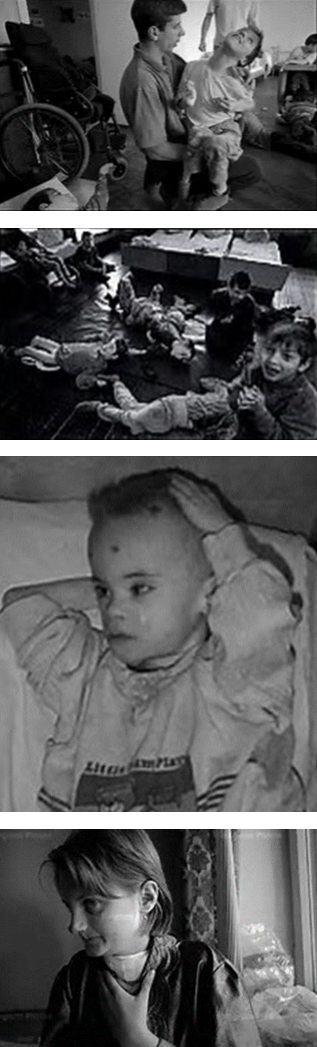
(up) Chernobyl Legacy, by Paul Fusco ...one of the greatest photo-journalism events of all time ...& unique in focusing on child victims of Chernobyl; (excerpts of book were made into three short video introductory segments — they are extremely emotionally honest & softly narrated by Paul Fusco — which, along with the book, should have a permanent home in the National Archives).
Photographs of Paul Fusco, from his book: Chernobyl Legacy
Photographs of Paul Fusco, from his book: Chernobyl Legacy
(Webmaster's note: I read published abstracts of scientific research studies, written by Chernobyl scientists, and learned exposure to radionuclides causes bacteria and viruses to mutate, causing new and mysterious diseases. It took you less than ten seconds to read the previous sentence …now, you know more than all the nuclear apologist bad science perps will ever admit.)
excerpt ~ Chernobyl: Consequences of the Catastrophe for People and the Environment
chapter 11
Chernobyl’s Radioactive Impact on Microbial Biota
by Alexey v. Yablokov
Abstract: Of the few microorganisms that have been studied, all underwent rapid changes in the areas heavily contaminated by Chernobyl. Organisms such as tuberculosis bacilli; hepatitis, herpes, and tobacco mosaic viruses; cytomegalovirus; and soil micromycetes and bacteria were activated in various ways. The ultimate long-term consequences for the Chernobyl microbiologic biota may be worse than what we know today. Compared to humans and other mammals, the profound changes that take place among these small live organisms with rapid reproductive turnover do not bode well for the health and survival of other species.
One gram of soil contains some 2,500,000,000 microorganisms (bacteria, micro-fungi, and protozoa). Up to 3 kg of the mass of an adult human body is made up of bacteria, viruses, and micro-fungi. In spite of the fact that these represent such important and fundamentally live ecosystems there are only scarce data on the various microbiological consequences of the Chernobyl catastrophe.
Several incidences of increased morbidity owing to certain infectious diseases may be due to increased virulence of microbial populations as a result of Chernobyl irradiation. … … …
All microorganisms (viruses, bacteria, fungi, and protozoa) and microbiological communities as a whole undergo rapid changes after any additional irradiation. The mechanism of such changes is well known: inclusion and increase in the frequency of mutations by natural selection and preservation of beneficial novel genes that for whatever reason appear more viable under the new conditions. This micro-evolutionary mechanism has been activated in all radioactively contaminated areas and leads to activation of old and the occurrence of new forms of viruses and bacteria.
All but a few microorganisms that have been studied in Chernobyl-affected territories underwent rapid changes in heavily contaminated areas.
Our contemporary knowledge is too limited to understand even the main consequences of the inevitable radioactive-induced genetic changes among the myriad of viruses, bacteria, protozoa, and fungi that inhabit the intestines, lungs, blood, organs, and cells of human beings.
The strong association between carcinogenesis and viruses (papilloma virus, hepatitis virus, Helicobacter pylori, Epstein-Barr virus, Kaposi’s sarcoma, and herpes virus) provides another reason why the cancer rate increased in areas contaminated by Chernobyl irradiation (for a review, see Sreelekha et al., 2003).
Not only cancer, but also many other illnesses are connected with viruses and bacteria. Radiologically induced pathologic changes in the microflora in humans can increase susceptibility to infections, inflammatory diseases of bacterial and viral origin (influenza, chronic intestinal diseases, pyelonephritis, cystitis, vaginitis, endocolitis, asthma, dermatitis, and ischemia), and various pathologies of pregnancy. The long-term consequences for microbial biota may be worse than what we understand today.
This micro-evolutionary mechanism has been activated in virtually all radioactively contaminated areas and leads to activation of old and the occurrence of new forms of viruses and bacteria.
[Editor's note:} Mainstream science, the nuclear energy industry and their apologists remain dumbfounded and swear on the bible there is more danger from natural radiation in eating bananas or potato chips or taking a walk in the park than eating or breathing in manmade ionizing fallout …from Fukushima or daily nuclear energy industry legal discharges, or accidents like Three Mile Island, Chernobyl and Fukushima.
Chernobyl: Consequences of the Catastrophe for People and the Environment, here
Book - Published by New York Academy of Sciences, Chernobyl: Consequences of the Catastrophe for People and the Environment was written by scientists who used health data from 1986 to 2004; edited by Janet Sherman.
Chapter 11 – Chernobyl’s Radioactive Impact on Microbial Biota
Alexey V. Yablokov
[Abstract] Of the few microorganisms that have been studied, all underwent rapid changes in the areas heavily contaminated by Chernobyl. Organisms such as tuberculosis bacilli; hepatitis, herpes, and tobacco mosaic viruses; cytomegalovirus; and soil micromycetes and bacteria were activated in various ways. The ultimate long-term consequences for the Chernobyl microbiologic biota may be worse than what we know today.Compared to humans and other mammals, the profound changes that take place among these small live organisms with rapid reproductive turnover do not bode well for the health and survival of other species.
One gram of soil contains some 2,500,000,000 microorganisms (bacteria, microfungi, and protozoa). Up to 3 kg of the mass of an adult human body is made up of bacteria, viruses, and microfungi. In spite of the fact that these represent such important and fundamentally live ecosystems there are only scarce data on the various microbiological consequences of the Chernobyl catastrophe.
Several incidences of increased morbidity owing to certain infectious diseases may be due to increased virulence of microbial populations as a result of Chernobyl irradiation.
1.-Soon after the catastrophe studies observed activation of retroviruses(Kavsan et al., 1992).
2.-There is evidence of increased susceptibility to Pneumocystis carinii and cytomegalovirus in children whose immune systems were suppressed in the contaminated territories of Novozybkov District, Bryansk Province (Lysenko et al., 1996).
3.-Tuberculosis became more virulent in the more contaminated areas of Belarus(Chernetsky and Osynovsky, 1993; Belookaya, 1993; Borschevsky et al., 1996). Address for correspondence: (Editor’s note: omitted.)
4.-In some heavily contaminated areas of Belarus and Russia there was a markedly higher level of cryptosporidium infestation(Lavdovskaya et al., 1996).
5.-From 1993 to 1997 the hepatitis viruses B, C, D, and G became noticeably activated in the heavily contaminated areas of Belarus (Zhavoronok et al., 1998 a, b).
6.-Herpes viruses were activated in the heavily contaminated territories of Belarus 6 to 7 years after the catastrophe (Matveev, 1993; Matveev et al., 1995; Voropaev et al., 1996).
7.-Activation of cytomegalovirus was found in the heavily contaminated districts of Gomel and Mogilev provinces, Belarus (Matveev, 1993).
8.-Prevalence of Pneumocystis was noticeably higher in the heavily contaminated territories of Bryansk Province (Lavdovskaya et al., 1996).
9.-The prevalence and severity of Gruby’s disease (ringworm), caused by the fungus microsporia Microsporum sp., was significantly higher in the heavily contaminated areas of Bryansk Province (Rudnitsky et al., 2003).
10.-The number of saprophytic bacteria in Belarussian sod-podzolic soils is at maximum with radioactivity levels of 15 Ci/km2 or less and minimal in areas 281 282 Annals of the New York Academy of Sciences with up to 40 Ci/km2 (Zymenko et al., 1995).
11.-There is a wide range of radionuclide bioaccumulations in soil micromycetes. The accumulation factor of Cs-137 in Stemphylium (family Dematiaceae) is 348 and in Verticillium (family Muctdinaceae) 28 (Zymenko et al., 1995).
12.-Since the catastrophe, the prevalence of black microfungi has dramatically increased in contaminated soil surrounding Chernobyl (Zhdanova et al., 1991, 1994).
13.-Among soil bacteria that most actively accumulate Cs-137 are Agrobacterium sp. (accumulation factor 587), Enterobacter sp. (60–288), and Klebsiella sp. (256; Zymenko et al., 1995).
14.-In all soil samples from the 10-km Chernobyl zone the abundance of soil bacteria (nitrifying, sulfate-reducing, nitrogen-fixing, and cellulose-fermenting bacteria, and heterotrophic iron-oxidizing bacteria) was reduced by up to two orders of magnitude as compared to control areas (Romanovskaya et al., 1998).
15.-In contaminated areas several new variants of tobacco mosaic virus appeared that affect plants other than Solanaceous species, and their virulence is most likely correlated with the level of radioactive contamination in the areas. Infection of tobacco plants with tobacco mosaic virus and oilseed rape mosaic virus was shown to induce a threefold increase in homologous DNA recombination in non-infected tissues (Boyko et al., 2007; Kovalchuk et al., 2003).
16.-All the strains of microfungi species that were studied (Alternaria alternata, Mucorhiemalis, and Paecilomyces lilacinus) from the heavily contaminated Chernobyl areas have aggregated growth of threadlike hyphae, whereas the same species from soil with low radionuclide contamination show normal growth. Only slowly growing Cladosporium cladosporioides has aggregated growth both in contaminated and TABLE 11.1. Characteristics of Oocysts of Coccidia (Eimeria cerna) in Voles (Clethrionomys glareolus) from Two Differently Contaminated Sites, Bryansk Province (Pel’gunov, 1996) Level of contamination 20μ R/h 180–220 ΜR/h Normal 94.5 76.6 Anomalous 06.3 Nonsporulated 5.2 12.2 lightly contaminated soils(Ivanova et al., 2006).
17.-Sharp reduction in the abundance of bifidus bacteria and the prevalence of microbes of the class Escherichia; in particular, a sharp increase in E. coli has been noted in the intestines of evacuee children living in Ukraine(Luk’yanova et al., 1995).
18.-In a long-term study (1954 to 1994—before and after the catastrophe) in Belarus, Ukraine, and Russia it was revealed that in areas with a high level of radioactive contamination (740–1,480 kBq/m2 and higher) in Bryansk, Mogilev, Gomel, Chernygov, Sumy, Kaluga, Oryol, Smolensk, and Kursk provinces, practically no cases of rabies in wild animals have been reported since the catastrophe (Adamovich, 1998). This suggests that the rabies virus has either disappeared or become inactivate.
19.-Rodents in the heavily contaminated territories of Belarus have been extensively invaded by coccids (obligate intracellular protozoan parasites from the phylum Apicomplexa; Sutchenya et al., 1995).
20.-There are fewer than normal, more anomalous, and no sporulated oocysts of coccidian Eimeria cerna in voles (Clethrionomys glareolus) in Bryansk Province (Table 11.1).
21.-Six years after the catastrophe a population of Eimeria cernae From Clethrionomys Glareolus living in heavily contaminated soil (up to 7.3 k Bq/kg of Cs-134, Cs-137, Sr-90, and Pu-106) in Kiev Province Yablokov: Radioactive Impact on Microbial Biota 283 had anomalous oocysts (Soshkin and Pel’gunov, 1994).
22. -There was a significant decline in the Shannon diversity index of infusoria species and a concomitant increase in their abundance in the Pripyat River mouth from 1986 to 1988 (Nebrat, 1992).
All microorganisms (viruses, bacteria, fungi, and protozoa) and microbiological communities as a whole undergo rapid changes after any additional irradiation.The mechanism of such changes is well known: inclusion and increase in the frequency of mutations by natural selection and preservation of beneficial novel genes that for whatever reason appear more viable under the new conditions. This micro-evolutionary mechanism has been activated in all radioactively contaminated areas and leads to activation of old and the occurrence of new forms of viruses and bacteria.All but a few microorganisms that have been studied in Chernobyl-affected territories underwent rapid changes in heavily contaminated areas.
Our contemporary knowledge is too limited to understand even the main consequences of the inevitable radioactive-induced genetic changes among the myriad of viruses, bacteria, protozoa, and fungi that inhabit the intestines, lungs, blood, organs, and cells of human beings.
The strong association between carcinogenesis and viruses (papilloma virus, hepatitis virus, Helicobacter pylori, Epstein–Barr virus, Kaposi’s sarcoma, and herpes virus) provides another reason why the cancer rate increased in areas contaminated by Chernobyl irradiation(for a review, see Sreelekha et al., 2003).
Not only cancer, but also many other illnesses are connected with viruses and bacteria. Radiologically induced pathologic changes in the microflora in humans can increase susceptibility to infections, inflammatory diseases of bacterial and viral origin (influenza, chronic intestinal diseases, pyelonephritis, cystitis, vaginitis, endocolitis, asthma, dermatitis, and ischemia), and various pathologies of pregnancy. The long-term consequences for microbial biota may be worse than what we understand today.
Published by New York Academy of Sciences, Chernobyl: Consequences of the Catastrophe for People and the Environment was written by scientists who used health data from 1986 to 2004; edited by Janet Sherman.
Chapter I. Chernobyl Contamination: An Overview —1. Chernobyl Contamination through Time and Space — Chapter II. Consequences for Public Health — 2. Public Health Consequences: Methodological Problems — 3. General Morbidity, Impairment, and Disability — 4. Accelerated Aging — 5. Nonmalignant Diseases — 6. Oncological Diseases — 7. Mortality — Chapter III. Consequences for the Environment — 8. Atmospheric, Water & Soil Contamination — 9. Flora — 10. Fauna — 11. Microbial Biota — Chapter IV. Radiation Protection after the Catastrophe — 12. Radioactive Contamination of Food and People — 13. De-corporation of Radionuclides — 14. Protective Measures for Activities in Radioactively Contaminated Territories — 15. Consequences for Public Health & the Environment, 23 Years Later
.
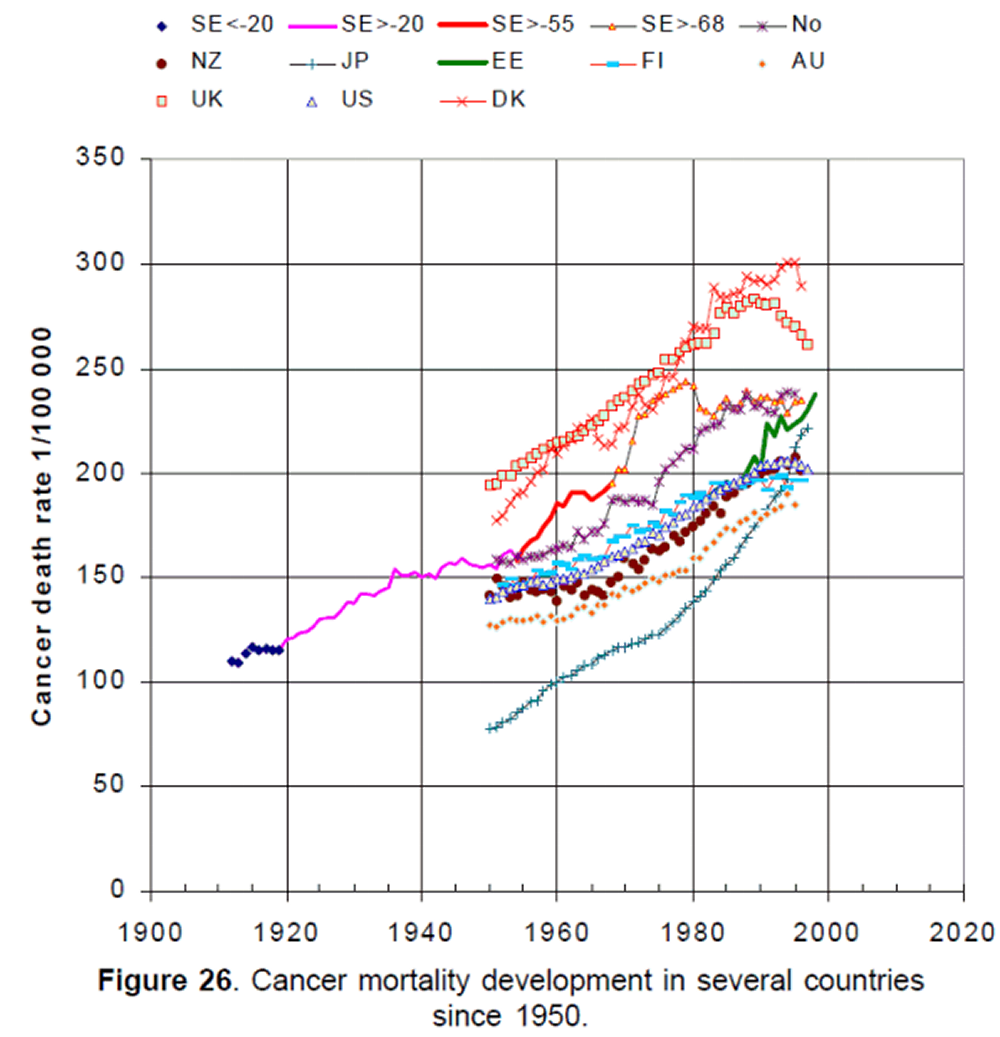
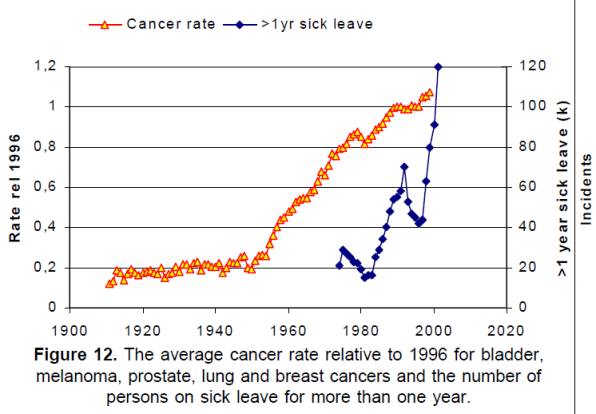
Our figure 03. cancer mortality development in several countries since 1950. note yearly time frames in figure 03, and compare them to yearly time frames in figures 01 & 02 ...this is part of the science of epidemiology, the location and frequency of excessive (unusually heightened) death rates in search of a reason ...such as, disease and/or unusual occurences ...and noting time frames of the beginning and end of the unusual occurences then comparing them to the beginning and end of the disease, to see how they match up perhaps in a causal relationship.
x
xx
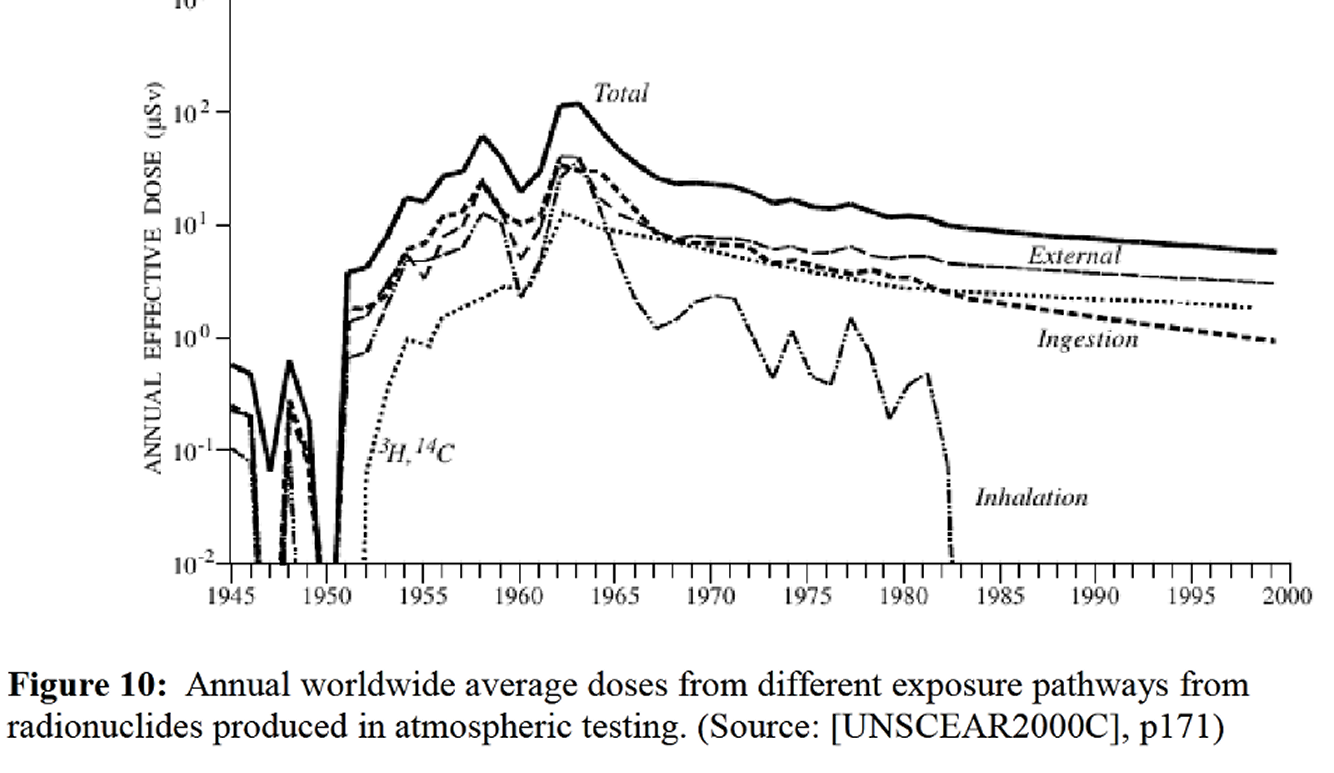
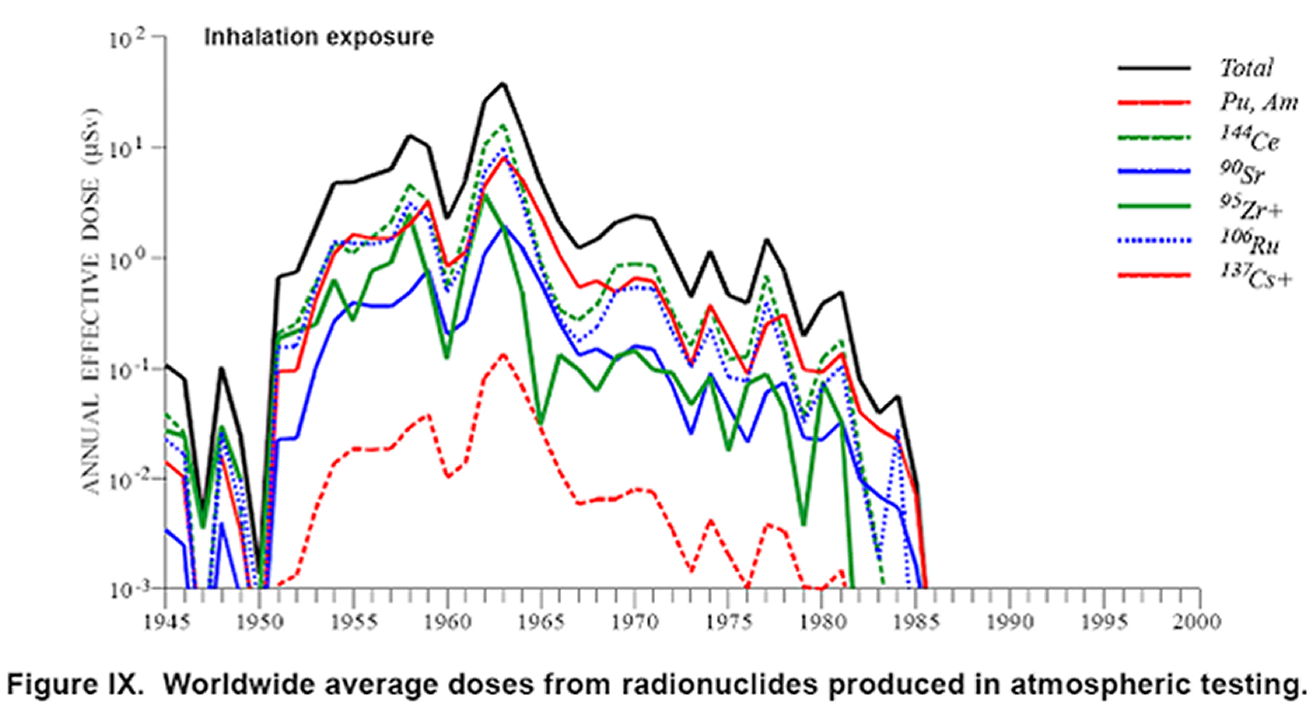
Our figure 01: annual worldwide average doses (in microsieverts) from different exposure pathways of radionuclides produced in atmospheric testing ~ includes inhalation, ingestion & external exposure [UNSCEAR2000C] ...(note) external exposure in the case of tritium: tritium changes from gas to liquid to solid and back at will; the radioactive hydrogen atom coming in contact with a non-radioactive hydrogen atom, converts the non-radioactive hydrogen to radioactive hydrogen. consequently tritium cannot be taken out of water (h20), because it has made the hydrogen atoms that constitute the water to be radioactive. when tritium externally comes into contact with your skin, since you are 65%-to-85% water, the tritium immediately enters your skin into your body. tritium rays do not shoot far, just far enough to destroy your dna. when you inhale, or eat tritium in garden vegetables uptaking radioactive water, for example, it redistributes inside you.
x
.
x
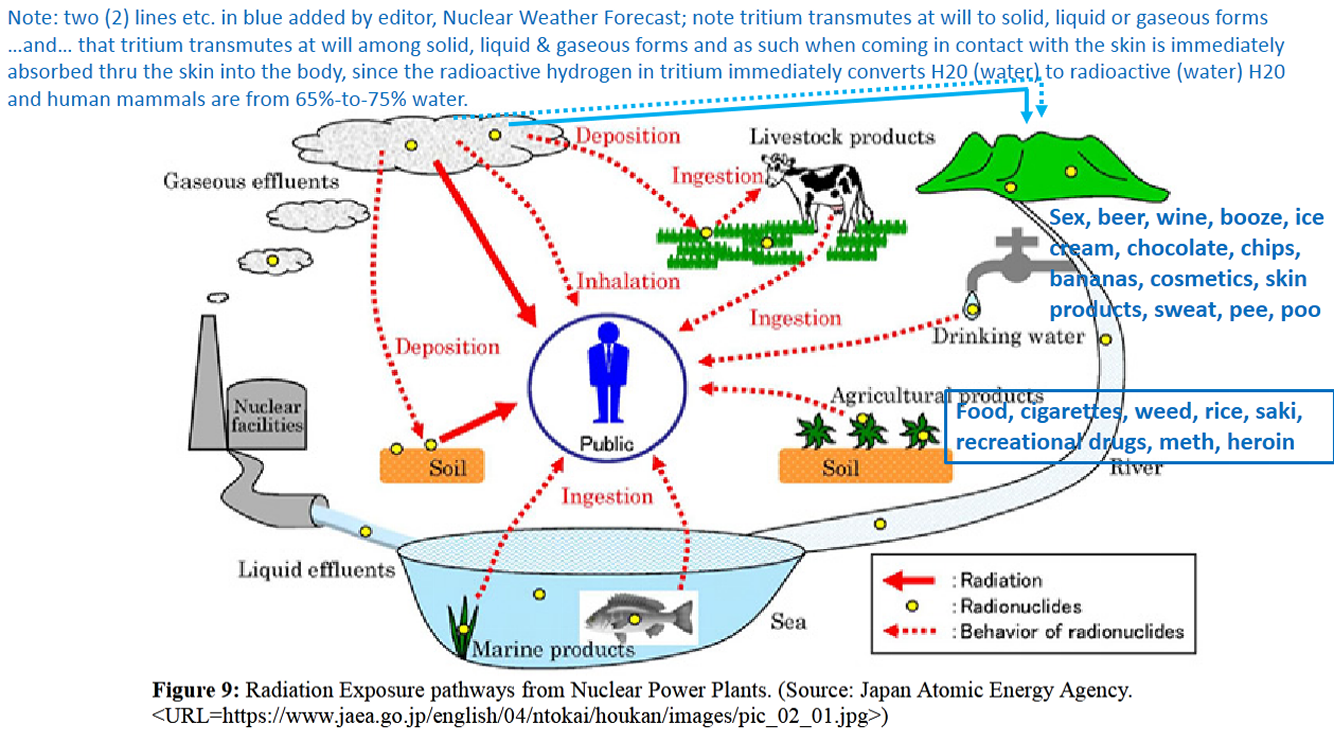
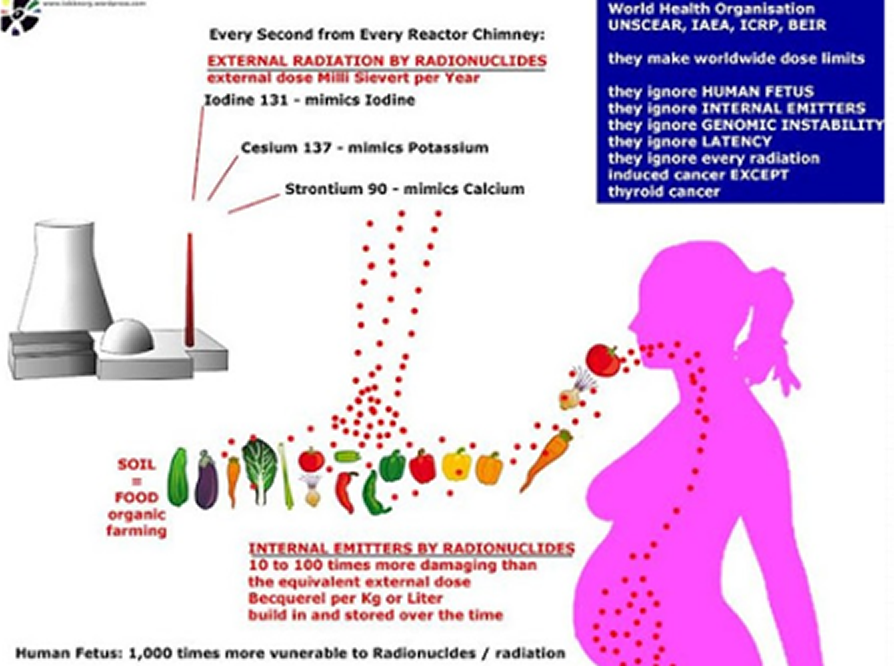
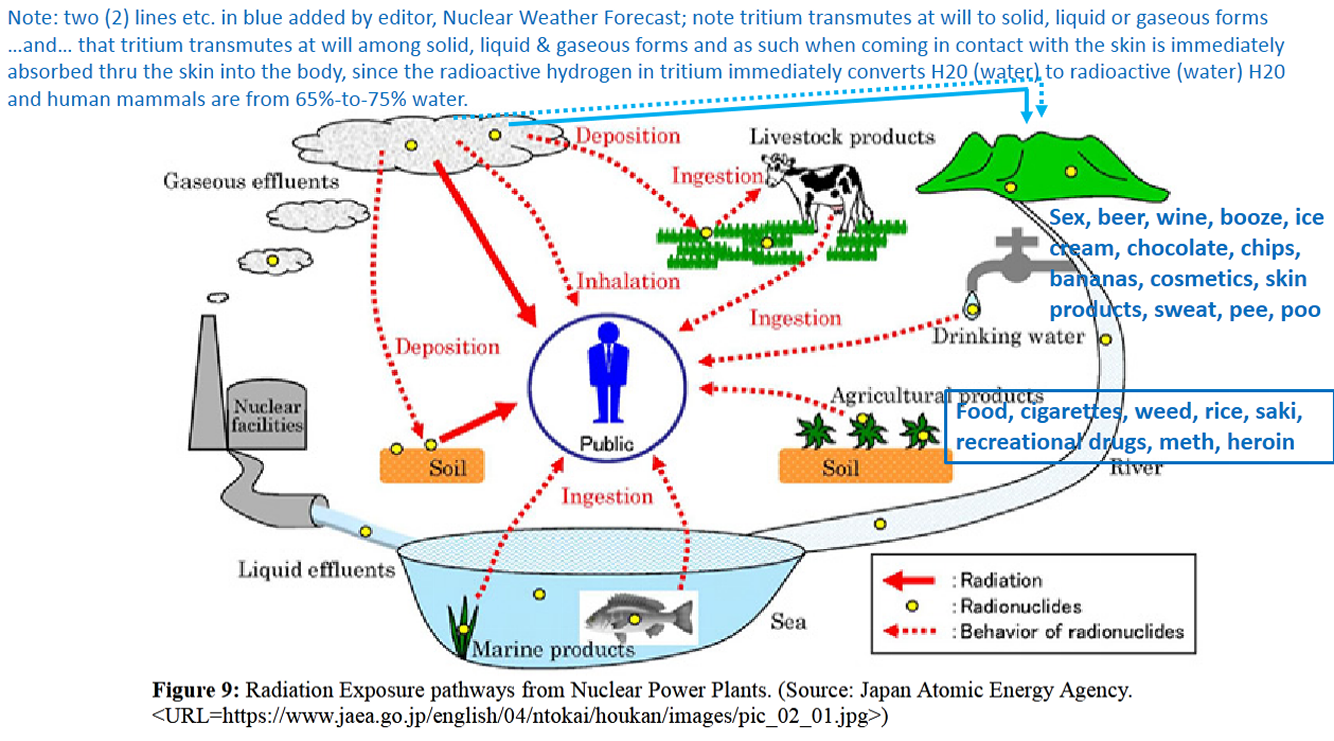
Our figure o5-a: radiation exposure pathways from nuclear power factories ...hmmm, they don't seem to object to it, like it's candy or money; but, do show the blue public figure without arms, so at least they're trying to be accurate. note there is a nuclear reactor in this picture that the nuclear fallout & waste comes from.
g
g
g
Our figure 02: worldwide average doses (in microsieverts) from radionuclides produced in atmospheric testing. note: there may be from 100-to-1,000 radionuclides present, but never tested for, usually only 1-to-2.
Lung cancer deaths in the world in relation to period of exposure to inhaled radionuclides produced by nuclear weapons testing 1945-1985.
m
m
Average cancer rate relative to 1996 for bladder, meloanoma, prostate, lung & breast and the number of persons on sick leave for more than a year.
xx
Our figure 02: worldwide average doses (in microsieverts) from radionuclides produced in atmospheric testing. note: there may be from 100-to-1,000 radionuclides present, but never tested for, usually only 1-to-2.
.
.
.
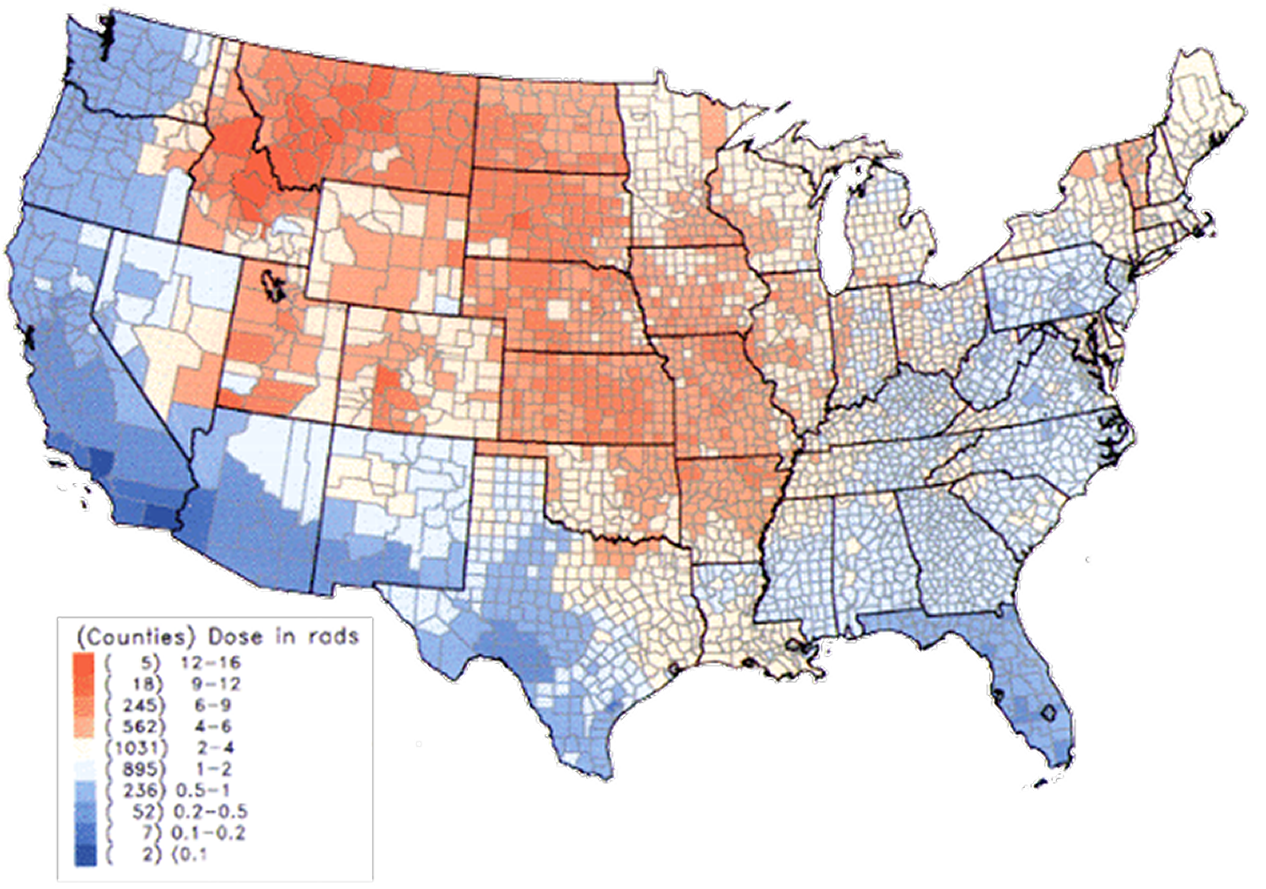
Our figure 04: usa collective exposure from nuclear testing (in rads). note: canada is excluded ...but, their diseases were/are suffered. (scientists say genetic mutation often also shows up in the 2nd &/or 3rd generation.)
Our figure 05-b: Radiation Exposure from nuclear power factories ...here, we've taken the opportunity to add some words in turquoise color & a couple lines & arrows, which we find informative for the america public. note there is a nuclear reactor in this picture that the nuclear fallout & waste comes from.
Our figure 03. cancer mortality development in several countries since 1950. note yearly time frames in figure 03, and compare them to yearly time frames in figures 01 & 02 ...this is part of the science of epidemiology, the location and frequency of excessive (unusually heightened) death rates in search of a reason ...such as, disease and/or unusual occurences ...and noting time frames of the beginning and end of the unusual occurences then comparing them to the beginning and end of the disease, to see how they match up perhaps in a causal relationship.
Our figure 01: annual worldwide average doses (in microsieverts) from different exposure pathways of radionuclides produced in atmospheric testing ~ includes inhalation, ingestion & external exposure [UNSCEAR2000C] ...(note) external exposure in the case of tritium: tritium changes from gas to liquid to solid and back at will; the radioactive hydrogen atom coming in contact with a non-radioactive hydrogen atom, converts the non-radioactive hydrogen to radioactive hydrogen. consequently tritium cannot be taken out of water (h20), because it has made the hydrogen atoms that constitute the water to be radioactive. when tritium externally comes into contact with your skin, since you are 65%-to-85% water, the tritium immediately enters your skin into your body. tritium rays do not shoot far, just far enough to destroy your dna. when you inhale, or eat tritium in garden vegetables uptaking radioactive water, for example, it redistributes inside you.
Our figure o5-a: radiation exposure pathways from nuclear power factories ...hmmm, they don't seem to object to it, like it's candy or money; but, do show the blue public figure without arms, so at least they're trying to be accurate. note there is a nuclear reactor in this picture that the nuclear fallout & waste comes from.
Arnie Gundersen
Nuclear reactor engineer, expert witness, educator, whistle blower, folk hero
Cell phone: pdf | Computer; msword w/pop-ups & search engine
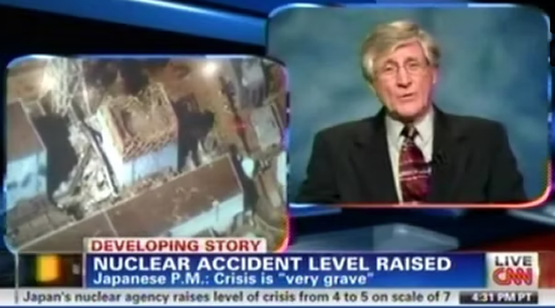
Arnie on CNN: 5 or 6 Cores of Spent Fuel at Fukushima nuclear reactor sites, Fairewinds Energy Education; https://vimeo.com/247838807
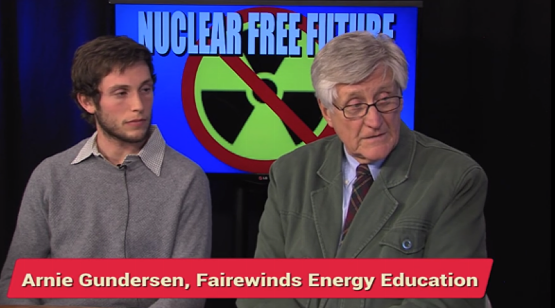
Arnie Gundersen & Ben Shulman-Reed; Fairewinds Energy Education; Arnie discusses Three Mile Island (TMI), Chernobyl & Fukshima meltdowns; https://vimeo.com/213779678
[Editor's note:] His nerdship Bill Gates wants to finish you off by spreading the cancer of sodium reactors killing you with (while robbing you of) your own taxdollars - (when did we ask Bill to rule Earth & run our lives?)
open letter from Arnie Gundersen, Fairewinds Energy Education (original text) ... to Bill Gates,(here)
Note: Excerpts - an an open letter from Arnie Gundersen — Fairewinds Energy Education (original text) ... to Bill Gates:Mr. Gates, during fifty years of developing nuclear power expertise, I learned that sooner or later, in any foolproof system, the fools are going to exceed the proofs …it’s time for you to face the music (and the facts): marketing hype associated with your latest “brainchild” ignores 70-years of fails usingliquid-sodium-based reactor coolant.
— Forbes Magazine: “Wyoming To Lead Coal-To-Nuclear Transition: Interest for nuclear plants growing beyond Wyoming as Montana, Nebraska, Utah, Idaho and North Dakota [explore] advanced nuclear reactors …brainchild of Bill Gates …has developed a 345 MW sodium-cooled fast reactor with a molten salt-based energy storage system.” — Scientific American, liquid sodium “dangerous as it is captivating … On contact with air, it burns; plunged into water, it explodes."
— Bulletin of Atomic Scientists: “Private industry tried in the 1960s to operate its own commercial-sized fast-breeder, Fermi I; benefits were negative. Barely three years after Fermi 1 came online, a partial fuel meltdown in 1966 brought it down.” — In the book. We Almost Lost Detroit, other sodium-cooled reactorfails in U.S. and worldwide.
American Nuclear Society, Admiral Rickover, founder of the nuclear Navy, testified to Congress in 1957: “We went to full power on the Seawolf ... on August 20 of last year. Shortly thereafter, she developed a small leak. It took 3 months, 24 hours a day, to locate and correct the leak." Rickover killed Navy’s sodium-powered reactor due to leaks, volatility,repairs and radiation exposure. — After failed attempts to use liquid sodium on the Seawolf and Fermi 1, nuclear zealots convinced U.S. Congress to subsidize a sodium-cooled reactor at Clinch River in Tennessee.
Rise and Demise of the Clinch River Breeder Reactor in Scientific American: “In 1982 …Energy Department videotape safety tests how molten sodium can react in contact with a reactor’s concrete containment. Concrete contains water crystals. Molten sodium reacts explosively with oxygen, including oxygen contained in water. The test demonstrated and video showed concrete exploding in contact with liquid sodium."
— Monju sodium reactor ... After cancelation of the Clinch River fiasco, those nuclear zealots continued to pursue the fantasy of a sodium-cooled fast breeder reactor at the Monju site in Fukui Prefecture, Japan. After 4-months, plagued by inevitable sodium leaks and sodium fires , Monju reactor had an emergency shutdown! The Monju sodium reactor took ten years to construct, ran intermittently for one year, and failed to operate for twenty years. Japan government's subsidized costs, exceeded $11 Billion.
Reuters: “With Monju’s shutdown, Japan’s taxpayers are left with at least 375 billion yen ($3.2 billion) to decommission its reactor, on top of 1 trillion yen ($8.5 billion) spent.” — Reuters, France has decided to cancel its sodium-cooled reactordesigns for at least half a century!
Mr. Gates, during my fifty years of developing nuclear power expertise, I have learned that sooner or later, in any foolproof system, the fools are going to exceed the proofs … it’s time for you to face the music (and the facts): the marketing hype associated with your latest “brainchild” ignores 70-years of fails using liquid-sodium-based atomic reactor coolant. — Arnold "Arnie" Gundersen, Chief Engineer, Fairewinds Energy Education
Kim Kardashian told her 58 million twitter followers she's "shocked and furious" to learn that smoke from the Woolsey Fire started at Santa Susana and is potentially radioactive. Kourtney Kardashian tweeted "our family lives only 20 miles from Santa Susana." SantaSusana Sodium Reactor near Los Angeles CA, in Simi Valley; 3-4 nuclear facility reactor meltdowns were completely covered up, 400x worse than Three Mile Island – radioactive Plutonium, Cesium, Strontium released over L.A. for over 20 years, to date, (here) & (here)
Kim Kardashian told her 58 million twitter followers she's "shocked and furious" to learn that smoke from the Woolsey Fire started at Santa Susana and is potentially radioactive. Kourtney Kardashian tweeted "our family lives only 20 miles from Santa Susana." SantaSusana Sodium Reactor near Los Angeles CA, in Simi Valley; 3-4 nuclear facility reactor meltdowns were completely covered up, 400x worse than Three Mile Island – radioactive Plutonium, Cesium, Strontium released over L.A. for over 20 years, to date, (here) & (here)
Extreme nuclear dangers | Tritium expose | Smokescreen | Hottest hot particle | Hot particles in seattle & boston | Nuclear power makes global warming worse |EPA guts protective action guidelines
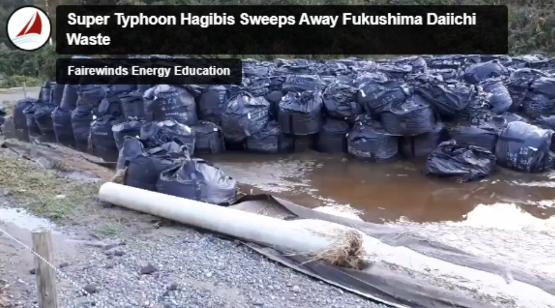
Officials say heavy rains carried the bags to the nearby Furumichi River. That river connects to another river and flows into the Pacific Ocean. The city retrieved ten bags from the river but they haven't been able to confirm how many went missing out of the more than 2,600 bags kept in a storage area.
Fukushima Daiichi’s radioactive waste is on the move again as Hagibis, the worst typhoon to hit Japan since 1958, dropped 30” of rain in 24 hours and millions of people were forced to evacuate due to flooding
From the minute we learned of this Super Typhoon threat, we were gravely concerned for the people of Japan and the tons of highly radioactive debris sitting on the edge of the volatile Pacific Ocean on the former site of the six Fukushima Daiichi atomic power reactors. Three of those nuclear power plants had meltdowns in March 2011 leaving more highly toxic radioactivity than anyone ever anticipated having in one spot. Some of that poisonous debris has been raked up and confined to thousands of giant 1-ton jumbo plastic bags that were right in the path of Hagibis. As we watched the news of the approaching Pacific super typhoon (tropical cyclone) with its 150 mile per hour (mph) winds, we worried for the people of Japan who have already faced the worst nuclear disaster on the planet. Since these events are just beginning to unfold, the amount of radioactive material released into the Pacific Ocean and surrounding environment is unknown as of Monday morning, October 14.
Maggie Gundersen, Chiho Kaneko and Caroline Phillips of Fairewinds Energy Education discuss the nuclear risk concerns for children not only near the nuclear disaster sites of Fukushima-Dai-ichiin Japan and Chernobyl in Ukraine, formerly the Soviet Union, but globally where areas near all nuclear power plants are contaminated with radiation. Since mothers in Japan especially bear the responsibility to protect children, they experience greater hardships in an environment where just expressing one’s concern about radiation is seen as a treasonous act. Even 30 years later, the Belarus government recognizes the merits of relocating children away from radiation contaminated areas but the children of Japan are socially forced to stay put in highly contaminated areas.
Maggie Gundersen, Chiho Kaneko & Caroline Phillips of Fairewinds.org interviewed by Margaret Harrington of CCTV Channel 17 in Burlington, Vermont, June 20, 2016: (here).
Do children suffer worldwide from atomic power? Absolutely. CCTV host Margaret Harrington anchored a panel with Maggie Gundersen, Caroline Phillips, and Chiho Kaneko from Fairewinds Energy Education to discuss the health risks to children around the world from operating nuclear power reactors and their burgeoning waste. In the aftermath of the nuclear meltdowns at Fukushima Daiichi, mothers in Japan especially bear the responsibility to protect their children. As a result, they experience greater hardships in an environment where just expressing one’s legitimate concerns about radiation contamination is seen as a treasonous act. Meanwhile in Ukraine, 30-years following the atomic disaster at Chernobyl, the repercussions of massive radioactive contamination and government zoning continue to severely impact children living within 50 miles of Chernobyl’s epicenter. The United States is not immune to these worries and contentions as Tritium, Strontium-90, and Cesium 137 are radioactive releases that threaten the health of children living nearby leaky atomic power reactors and nuclear waste dumps. Learn more by watching this episode of Nuclear Free Future as the women of Fairewinds lend their voices to protect the children.
(click pic)
Gee, once my kids are dead, does that mean I don't have to support them anymore?
Fairewinds video interviews & transcripts
Children Suffer Nuclear Impact Worldwide
Contrary to cartoon superheroes: Kids don't get superpowers from routine-everyday nuclear industry reactor fallout, waste & accidents – instead: immune deficiency diseases, cancer & leukemia
Maggie Gundersen, Chiho Kaneko & Caroline Phillips of Fairewinds.org interviewed by Margaret Harrington of CCTV Channel 17 in Burlington, Vermont, June 20, 2016: (here). Original transcript by Fairewinds; scroll down, (here). Formatted & edited oral history transcript by Nuclear Weather Forecast, (PDF, here) - or - (with MS Word search engine, footnotes, endnotes, charts & supplementary information, here)
| Children Suffer Nuclear Impact Worldwide | Extreme Nuclear Dangers | Tritium Expose | Smokescreen | Hottest Hot Particle | Hot Particles in Seattle & Boston | Nuclear Power Makes Global Warming Worse | Sabotage: EPA Guts Protective Action Guidelines |
Special Feature: Fairewinds video interviews & transcripts
(Fairewinds interviews below were edited from originals on the Fairewinds website by editors of, The Pacific Ocean is Dying & You Don't Even Know; & subheads were added by the editors of, The Pacific Ocean is Dying & You Don't Even Know, & are excerpted from, The Pacific Ocean is Dying & You Don't Even Know — NOTE: exhibits, & links to ENEnews summaries when they appear are NOT part of original Fairewinds interviews, but added by our editors.)
cell phone: pdf — computer: use ms word w/find-search engine
| Children Suffer Nuclear Impact Worldwide, pgs 1-21(cell phone: pdf – computer: ms word)
| Welcome to my World, pgs 22-35(cell phone: pdf – computer: ms word)
| Extreme Nuclear Dangers (cell phone: pdf – computer: ms word)
| Tritium Expose, pgs 7-17, Fairewinds interview begins several paragraphs under the heading: 'Let the Games Begin: We Almost Lost Detroit'(cell phone: pdf – computer: ms word)
| Hottest Hot Particle (cell phone: pdf – computer: ms word)
| Hot Particles in Seattle & Boston (cell phone: pdf – computer: ms word)
| Nuclear Power Makes Global Warming Worse (cell phone: pdf – computer: ms word)
| EPA Wrecks Protective Action Guidelines (cell phone: pdf – computer: ms word)
Christina RadChick Consolo
Fukushima triggers jump in airline pilot & passenger heart attacks, cancers, rad symptoms
Flight emergencies — we analyze daily ...doors fall off, pipes break, babies have heart attacks — by Christina Consolo (RadChick)
When I did this interview with Alfred in Feb of 2014 I thought I was done with the plane stuff for awhile, and would continue to collect data and maybe revisit this topic in a year or so – and see how flight crews were faring flying another year through fallout. A close friend I have known since childhood (who is a nuclear decommissioning specialist) reviewed my data and told me he would be much more concerned with the planes "falling apart" from Wigner, than the pilots passing out - as that is 'recoverable' in most cases. Shortly after this meeting, MH370 happened.
Then another crash, then MH17...then another crash...and on and on...I recently told my daughter, I feel like I have been cramming for finals since February. I never expected there to be so many crashes, missing planes, planes shot down, ALL the flight emergencies we now analyze on a daily basis, doors falling off, pipes breaking, babies having heart attacks, passengers being out-of-control...but this...THIS newest one... AirAsia flight QZ8501... has my head spinning.
This was very unexpected, and I am very very disturbed by it. Already there is weirdness happening over and above the event itself. I have already been asked "When will you do an interview about AirAsia" and it hasn't been even 24 hours yet. One of the most important things we can do right now is collect every single story, tweet, and post about this, to save for perusal later. Early into events like these there is a LOT of disinfo but there is also a lot of truth, that may be scrubbed later (as in the case of MH370 & MH17). I hope to see Alfred cover this with Leuren Moret, because the work they have done with MH370 & MH17 is some of the most mind-blowing yet sensical stuff ever covered as far as aviation accidents, and the politics behind some of these events. In the meantime, let's hope they find this latest missing plane. I can not even begin to imagine how hard this is for the families of the passengers, and those who are STILL waiting to hear about their loved ones and MH370.
Fukushima triggers jump in airline pilot & passenger heart attacks, cancers, rad symptoms
The affects of airborne radionuclide fallout on pilots & passengers on airliners
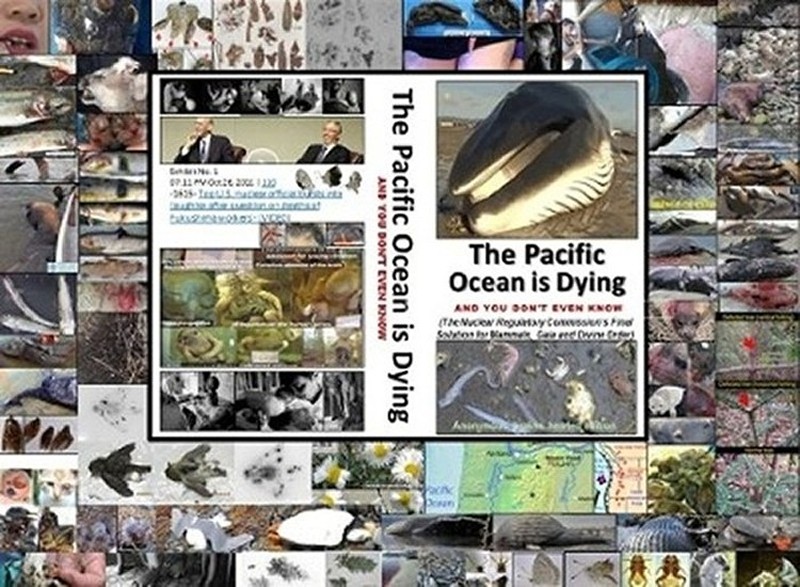
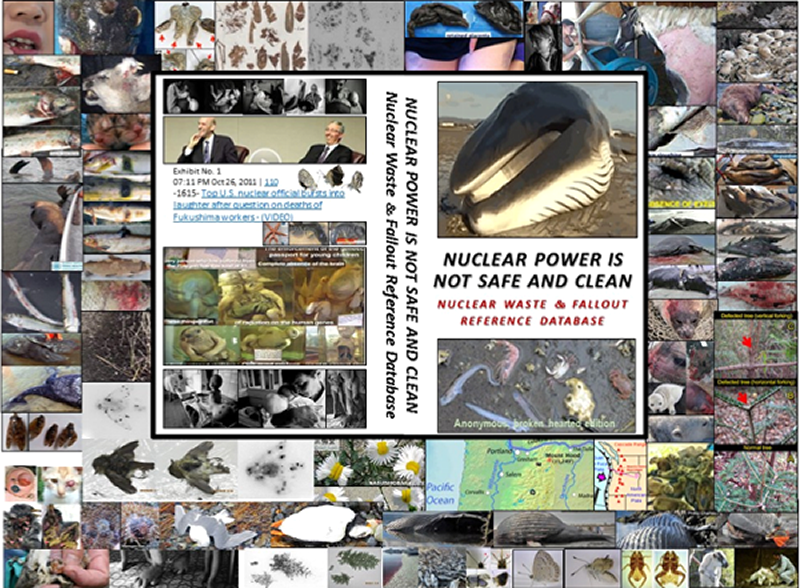
Samples: subjective interpretive e-book narrative Subjective descriptive interpretive narrative of the information in our nuclear waste & fallout reference database proves nuclear energy, reactors & industry is not safe & clean
Samples: objective e-book database 8,012 listings Objective descriptive narrative database of 8,011 headlines each link to three-to-five (3-5) blurbs of published articles &/or scientific studies together linked to 25,000-to-35,000 original documents proves nuclear energy, reactors & industry is not safe & clean
Pacific Ocean radioactive contamination from Fukushima meltdowns
Nuclear waste & fallout affects: ...micro-evolutionary mechanism is activated in virtually all radioactively contaminated areas & leads to activation of old & occurrence of new forms of viruses & bacteria. [Radioactivity leads to] ...activation of old & occurrence of new forms of viruses & bacteria & new diseases ...(never seen before)
Pacific Ocean Dying: The 'new & mysterious' diseases of ocean life are not caused by the fake news 'red blob' of warm water ...they are caused by seaborne nuclear fallout & waste (here) that mutates viruses & bacterial to form new & mysterious diseases, (here). And, by military oceanic use of depleted uranium shells for target practice blowing up ships & military use of ionospheric heaters, military & oil company use of sonar (that bursts the ear drums of whales, dolphins & other sea life & disorients them) & oil company use of sonar-like sonic booms every few seconds for weeks for sounding out oil deposits beneath the ocean floor.
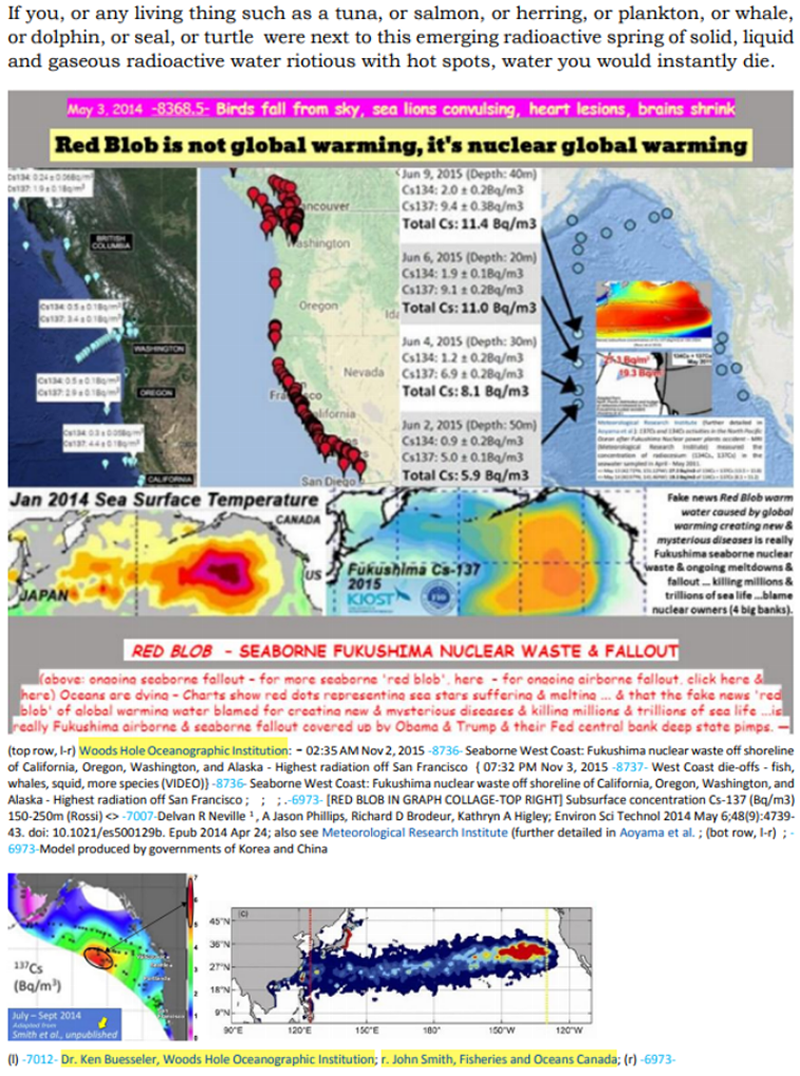
RED BLOB – SEABORNE FUKUSHIMA NUCLEAR WASTE & FALLOUT
(above: ongoing seaborne fallout – for more seaborne 'red blob', here – for ongoing airborne fallout, click here & here) Oceans are dying – Charts show red dots representing sea stars suffering & melting ... & that the fake news 'red blob' of global warming water blamed for creating new & mysterious diseases & killing millions & trillions of sea life ...is really Fukushima airborne & seaborne fallout covered up by Obama & Trump & their Fed central bank deep state pimps.—(more Red Blob, here)—
12:28 PM Jan 30, 2014-7030-West Coast sea stars rip themselves apart – innards spill out – melt to mush – vaporize(VIDEO)
Nuclear waste & fallout affects: ...micro-evolutionary mechanism is activated in virtually all radioactively contaminated areas & leads to activation of old & occurrence of new forms of viruses & bacteria. [Radioactivity leads to] ...activation of old & occurrence of new forms of viruses & bacteria & new diseases ...(never seen before)
Nuclear fallout marine mortality Marine mammal die-offs Whale deaths Pacific Ocean Seal die-offs Plankton radioactive exposure Pacific Seabird mortality radiation Fish population collapse Invertebrate mass mortality
Mussels, barnacles, limpet, rock shell, sea anemones mass die-off
11:24 AM Feb 10, 2016 -8773- Fukushima: Intertidal biota by power plant - mass die off and reproductive failure of sessile species; (sessile refers to organisms anchored to rocks and piers, mussels, barnacles, limpet, rock shell, sponges, sea anemones, fan worms, chitons, gastropods, bivalves, crustaceans, echinoderms). http://www.nature.com/articles/srep20416
Seals & sea lions at risk
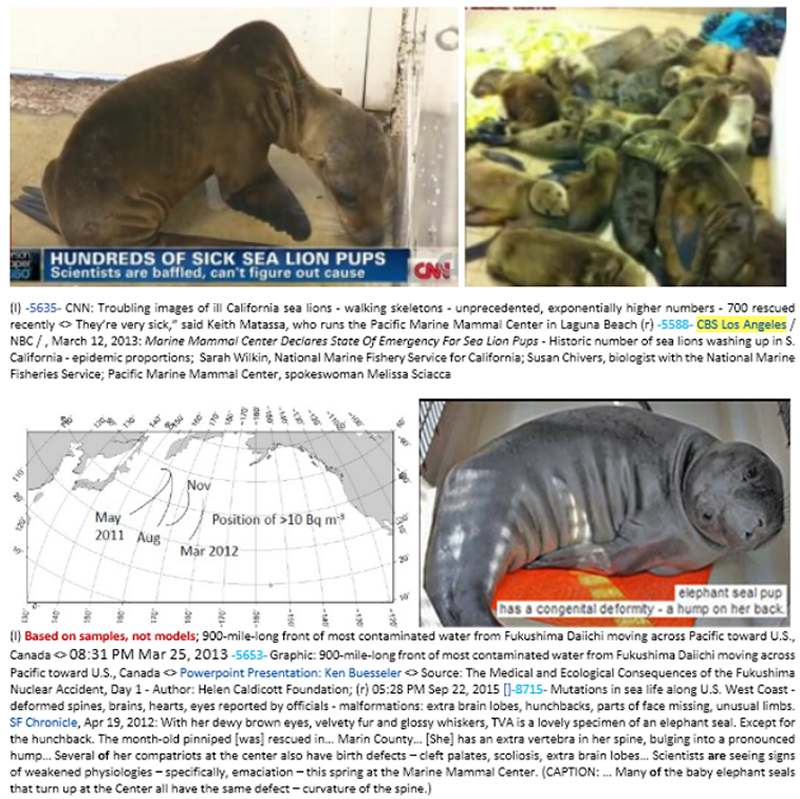
11:19 AM Jan 7, 2016 -8758- West Coast - 200,000 sea lions at risk; sick animals eating themselves from the inside - cancer includes liver, pancreas; intestines shut down; infested with parasites & immune to antibiotics; numbers of dead or starving seals wash ashore (VIDEO)
Dead animals litter California beaches
07:26 AM Apr 25, 2016 -8809- Dead animals litter California beaches - graveyard of washed-up sea life - malnourished sea creatures - starving to death - Covered in sores - stunted growth - Weak immune systems (PHOTO & VIDEOS)
Pacific Ocean: Chunks missing from bodies of salmon from Pacific - lesions in 50% of fish
04:18 PM Aug 31, 2014 -8399- Pacific Ocean: Chunks missing from bodies of salmon from Pacific - lesions in over 50% of fish being reported - followed by bacterial invasions (PHOTO)
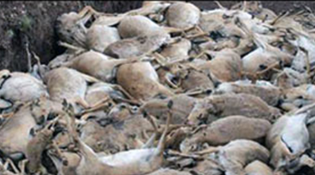
150,000 Antelopes near nuclear site bleed from internal organs: Pits brimming with corpses
06:30 PM Sep 8, 2015 -8708- Rapid and complete die-off of animals near nuclear site - 150,000 antelopes bleeding from internal organs, pits brimming with corpses (PHOTOS)
[Editor's note:] Mainstream science, the nuclear energy industry and their apologists remain dumbfounded and swear on the bible there is more danger from natural radiation in eating bananas or potato chips or taking a walk in the park than ingesting (eating or breathing) manmade ionizing fallout …from Fukushima or daily nuclear energy industry legal reactor discharges, or accidents like Three Mile Island, Chernobyl and Fukushima.
Whale strandings, cancer in seals, collapse of fish stocks — Plutonium radionuclide hot spots in Pacific Ocean can continue killing for hundreds to thousands of years
06:45 PM Sep 2, 2015 -8705- West Coast: Whale strandings, cancer in seals, collapse of fish stocks (PHOTOS & VIDEO - whale final gasps on beach) See VOA story
California sea lions dying from organs falling out of place, tumors, accumulation of pus inside bodies
-8702.2-8408- California sea lions dying from organs falling out of place, tumors, accumulation of pus inside bodies (PHOTO)
Baby Elephant seals & sea lions (mammals) die of leukemia-linked disorder
03:53 PM Aug 26, 2015 -8702- California Coast: Many baby seals dying of leukemia-linked disorder - 1/3 of recent deaths at San Francisco Bay rescue center (CHART)
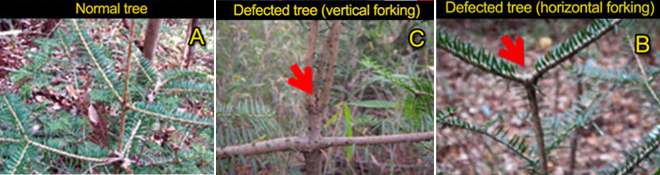
Trees do not have a top bud, without which its growth cannot continue
03:44 PM Aug 31, 2015 -8704- Radiation fears growing as government finds strangely deformed trees around Fukushima - Nearly 100% have morphological defects - Trees did not have a top bud, without which its growth cannot continue - Effects worsening over time - Researchers prevented from doing studies… so little data (PHOTOS & VIDEO)
Radiation spikes to all-time record highs in ocean off Fukushima plant
08:46 AM May 18, 2014 -8234- Japan Times: Radiation spikes to all-time highs in ocean off Fukushima plant - record-high radiation levels have been observed TEPCO says - Officials: Cause of spike unknown
Tons of highly radioactive liquid pour out of Reactor No. 2 each day
12:47 PM May 14, 2014 -8231- Tons of highly radioactive liquid pour out of Reactor No. 2 each day - Caroline Kennedy at plant(VIDEO)
Pulsed release: Alaska seal lesions, deaths
10:40 AM Jan 25, 2014 -6982-Alaska seal deaths & Fukushima fallout - skin lesions, hair loss, lethargy – pulsed release … built-up radionuclides set free as ice melts - wildlife health implications due to radiation exposure (PHOTOS & MAP)
Little animals suffer, too
03:14 PM May 15, 2014-8232- Butterflies: Death and mutations increase from exposure to Fukushima contamination; small level of cesium from Fukushima toxic to butterfly populations
.
Sea stars decimated on West Coast
02:21 PM Apr 5, 2014 -8145- Sea stars decimated on West Coast - SoCal ravaged as mystery disease spreads south; hundreds last year, now none - hit hard - mortality event like this never before documented - uncharted waters - likes of which we haven’t seen - turn to bacterial goop - (RADIO)
Insect abnormalities
11:23 AM Apr 7, 2014 -8150- Deformities high in Fukushima insects - Lower body split in half, two tail-like appendages - 1,000% higher death rate in young - (PHOTOS)
Lesions prevent birds from eating & breathing
11:38 AM Feb 21, 2015 -8572- California coast: Epidemic; mass die-off; lesions prevent birds from eating, breathing (PHOTOS)
08:20 PM Sep 6, 2014 -8408- California sea lions dying from organs falling out of place, tumors, accumulation of puss inside bodies — Marine mammal deaths reported by The Marine Mammal Center (Sausalito, Calif) since June 2014 (domoic acid-related deaths excluded)(PHOTOS)
01:26 PM May 6, 2015 -8627- U.S. university tests animals in Pacific for Fukushima radiation - bodies riddled with tumors, eyes bleeding, covered in lesions - Some are missing testicles, eyeballs - Skin disintegrates, peels off, turns yellow - Mammals affected by diseases never seen in species (PHOTOS)
10:03 AM May 16, 2014 -8233- Alaska, Bering Strait: Seals, walruses - livers crumble - hearts enlarge, lymph nodes yellow, blood-filled lungs; 300 seals found suffering hair loss, skin sores, lethargic behavior; dozens of walruses found with similar sores (PHOTOS) (AUDIO)
Leukemia is one of the most common cancers induced by radiation in humans (mammals)
-8702.1- also see: Physics and Radiobiology of Nuclear Medicine (Springer), Jun 29, 2013: Leukemia is one of the most common cancers induced by radiation in humans, accounting for one in five mortalities from radio-carcinogenesis. Risk of leukemia varies with age, younger persons more prone to radio-carcinogenesis - Leukemia appears as early as 2-3 years after exposure, average latent period of 5 to 10 years.
Effect of nuclear waste & fallout: This micro-evolutionary mechanism has been activated in virtually all radioactively contaminated areas and leads to activation of old and the occurrence of new forms of viruses and bacteria ...that create new diseases never before seen
California sea lions excruciating suffering & dying from organs falling out of place, tumors, accumulation of puss inside bodies
(Extended story) 08:20 PM Sep 6, 2014 -8408- California sea lions dying from organs falling out of place, tumors, accumulation of puss inside bodies (PHOTOS)
Marine mammal deaths reported by The Marine Mammal Center (Sausalito, Calif) since June 2014 (domoic acid-related deaths excluded):
(12) Abscess: Collection of pus… in the tissue of the body
(1) Carcinoma: Cancer that begins… when altered or damaged DNA occurs to such an extent that the cells become transformed, and begin to exhibit abnormal malignant properties.
(1) Cardiomyopathy: Heart muscle disease… deterioration… of the… heart muscle… usually leading to heart failure
(1) Coccidioidomycosis: Fungal disease… Serious complications may occur in patients with weakened immune systems
(2) Disseminated Intravascular Coagulation: Blood clots that can lead to multiple organ damage… clotting is disrupted and severe bleeding can occur
(7) Neoplasia: Commonly referred to as a tumor… A malignant neoplasm is a cancer
(6) Otostrongylus: Lungworms… in lungs or heart of seals
(3) Peritonitis: Inflammation of… tissue that lines the inner wall of the abdomen… may result from infection (often due to rupture of a hollow organ)
(4) Pneumonia: Inflammatory condition of the lung
(6) Prolapse: Latin for to fall out - Organs, such as the uterus, fall down or slip out of place… organs protruding through the vagina or the rectum
(3) Pyothorax: Accumulation of pus in the pleural cavity
(2) Renal Failure: Kidneys fail to adequately filter waste products from the blood
(5) Septicemia: Potentially fatal whole-body inflammation caused by severe infection
Radiation spikes to all-time record highs in ocean off Fukushima site
08:46 AM May 18, 2014 -8234- Japan Times: Radiation spikes to all-time highs in ocean off Fukushima plant - record-high radiation levels have been observed TEPCO says - Officials: Cause of seawater spike is unknown
12:47 PM May 14, 2014 -8231- Tons of highly radioactive liquid pour out of Reactor No. 2 each day - Caroline Kennedy at plant (VIDEO)
Pulsed release - Alaska seal lesions, deaths
10:40 AM Jan 25, 2014 -6982- Alaska seal deaths & Fukushima fallout - skin lesions, hair loss, lethargy-[1]-[i]- pulsed release … built-up radionuclides set free as ice melts - wildlife health implications due to radiation exposure (PHOTOS & MAP)
[ii] (Note: The following two endnotes accompany this info.) Alaska Marine Science Symposium (pdf), Jan. 20-24, 2014 (emphasis added): 2011 Fukushima Fall Out: Aerial Deposition On To Sea Ice Scenario And Wildlife Health Implications To Ice-Associated Seals (Dr. Doug Dasher, John Kelley, Gay Sheffield, Raphaela Stimmelmayr) - On March 11, 2011 off Japan’s west coast, an earthquake-generated tsunami struck the Fukushima Daiichi nuclear power plant resulting in a major nuclear accident that included a large release of airborne radionuclides into the environment. Within five days of the accident atmospheric air masses carrying Fukushima radiation were transiting into the northern Bering and Chukchi seas. During summer 2011 it became evident to coastal communities and wildlife management agencies that there was a novel disease outbreak occurring in several species of Arctic ice-associated seals. Gross symptoms associated with the disease included lethargy, no new hair growth, and skin lesions, with the majority of the outbreak reports occurring between the Nome and Barrow region. NOAA and USFWS declared an Alaska Northern Pinnipeds Usual Mortality Event (UME) in late winter of 2011. The ongoing Alaska 2011 Northern Pinnipeds UME investigation continues to explore a mix of potential etiologies (infectious, endocrine, toxins, nutritious etc.), including radioactivity. Currently, the underlying etiology remains undetermined. We present results on gamma analysis (cesium 134 and 137) of muscle tissue from control and diseased seals, and discuss wildlife health implications from different possible routes of exposure to Fukushima fallout to ice seals. Since the Fukushima fallout period occurred during the annual sea ice cover period from Nome to Barrow, a sea ice based fallout scenario in addition to a marine food web based one is of particular relevance for the Fukushima accident. Under a proposed sea ice fallout deposition scenario, radionuclides would have been settled onto sea ice. Sea ice and snow editor’s note - index: snow would have acted as a temporary refuge for deposited radionuclides; thus radionuclides would have only become available for migration during the melting season and would not have entered the regional food web in any appreciable manner until breakup (pulsed release). The cumulative on-ice exposure for ice seals would have occurred through external, inhalation, and non-equilibrium dietary pathways during the ice-based seasonal spring haul-out period for molting/pupping/breeding activities. Additionally, ice seals would have been under dietary/metabolic constraints and experiencing hormonal changes associated with reproduction and molting.
Radiation from Fukushima, APRN (Alaska Public Radio Network), Jan. 24, 2014: They’re having trouble sealing up the leaking nuclear power plants in Japan and they’re also having trouble disclosing what is going on there. Is this a reason to distrust Alaska seafood?
Researchers: Skin ulcers on Alaska wildlife after Fukushima were never observed before -- Also reported in seals from Japan -- We couldn’t document fallout pattern when plumes hit and animals were on the ice (AUDIO
Little animals suffer, too
03:14 PM May 15, 2014 -8232- Butterflies: Death and mutations increase from exposure to Fukushima contamination; small level of cesium from Fukushima toxic to butterfly populations
Seals & walruses suffer
01:26 PM May 6, 2015 -8627- U.S. university testing animals in Pacific for Fukushima radiation - bodies riddled with tumors, eyes bleeding, covered in lesions - Some are missing testicles, eyeballs - Skin disintegrates, peels off, turns yellow - Mammals affected by diseases never seen in species (Photos)
10:03 AM May 16, 2014 -8233- Alaska, Bering Strait: Seals, walruses - livers crumble - hearts enlarge, lymph nodes yellow, blood-filled lungs; 300 seals found suffering hair loss, skin sores, lethargic behavior; dozens of walruses found with similar sores (PHOTOS) (AUDIO)
(1) Liver may crumble easily and discharge blood — (2) The heart is frequently enlarged and pale - granular, dry, and soft/decaying tissue — 3) Tissues may be congested, and blubber underneath lesions may be fluid-filled or have focal areas of inflammation — (4) Lymph nodes are often enlarged and swollen with an excessive accumulation of fluid. Lymph nodes may also look yellow and/or mottled. This shows the typical look of the lungs, which is very consistent between cases.
Sharp Rise in Whale Deaths Being Investigated - Since May, 30 dead whales have washed ashore on the Gulf of Alaska. (Deborah Fauquier, NOAA): ‘And the average for the whole year generally is 8, so it’s definitely significantly elevated and for us that was a reason for concern.’ The Extreme Mortality Event, as scientists are calling it, has triggered an investigation.
Huffington Post, Sep 1, 2015: Radiation in the Ocean - The West Coast of the United States seems under siege by negative environmental news… and numerous accounts of unusual coastal events: algae blooms, whale strandings, cancer in seals, collapse of fish stocks, and more… One argument has been the effect of radiation leaking from the [Fukushima] nuclear power plant reactors… and has been thereafter distributed by ocean currents; indeed there is evidence of a plume of increased concentration of Cesium-134, and other radioactive elements that have been observed at unprecedented levels, spreading out some 5,000 miles into the Pacific… In April of this year, there were headlines declaring that Fukushima radiation has reached the North American Shore and concerns were raised, spread through the Internet and press, that this was surely the cause of these otherwise inexplicable anomalous natural events. There is no Federal agency that funds monitoring of radiation in coastal water… So, yes, and no. No definitive conclusion, no clear argument that radiation is the cause of those coastal events which distress us so… The question is immensely important…
VOA, Sep 1, 2015: While President Barack Obama is in Alaska, he might have this question: Why have 30 dead whales washed ashore… [NOAA's] Fauquier said the extreme mortality event was complicated… Fauquier noted that in the ocean, toxins move up the food chain. Some of the whales actually filter the phytoplankton and the zooplankton… they get the toxins through that method... as you go higher up the food web, more toxin gets concentrated.... NOAA hopes to explain why whales died and why they perished in such great numbers.
Cordova Times, Aug 28, 2015: Whales..Thirty dead whales ….And no one knows why… when thirty of them die in four months, three times the usual rate, something is not right…. between 700 deaths over the years, scientists have managed to perform two full necropsies. For this particular event, they’ve done one limited necropsy… While they keep an eye on algae, they have been testing all possibilities. Possibilities like fallout from Fukushima, and while they did radiation testing as part of the limited autopsy, it came back with background levels that would occur normally in Alaska, said Julie Speegle, speaking on behalf of NOAA.
Newsweek, Aug 27, 2015: Over last few months, dead whales are appearing regularly on beaches along Northern California coast. And, 30 whale carcasses washed up along the coast of Alaska, puzzling scientists.
Washington Post, Aug 30, 2015: Concerns mount as whales are found dead in Gulf of Alaska - Researchers are scrambling to determine what’s behind the death of 30 whales… Other dead whales have been reported off the coast of British Columbia…. starvation or disease could be behind the deaths… The more likely culprit is unusual water conditions.
NPR, Sep 1, 2015: Researchers say record low oxygen levels in Hood Canal are causing marine life to die off. Marine life is struggling to survive… We have been seeing lots and lots of dead fish on beaches, said Seth Book, with the Skokomish Tribe’s Department of Natural Resources… This is really the worst year in terms of the oxygen, said Jan Newton, an oceanography professor at the University of Washington… .
(click pic) First Occupy movement: Protest vs Wall Street & nuclear power — defends 99.99% against 0.001% central bankers, monarchs & rogue billionaires
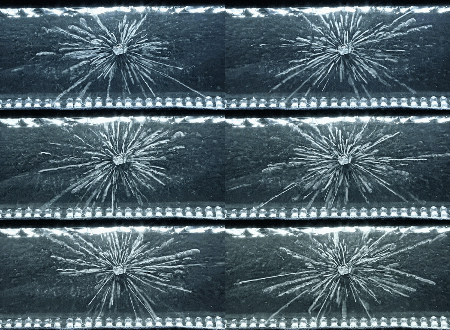
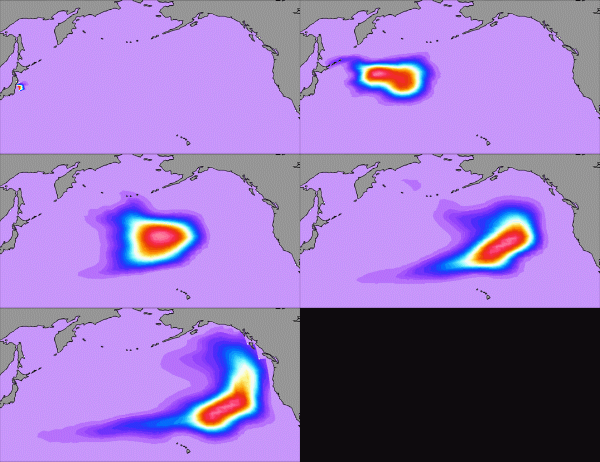

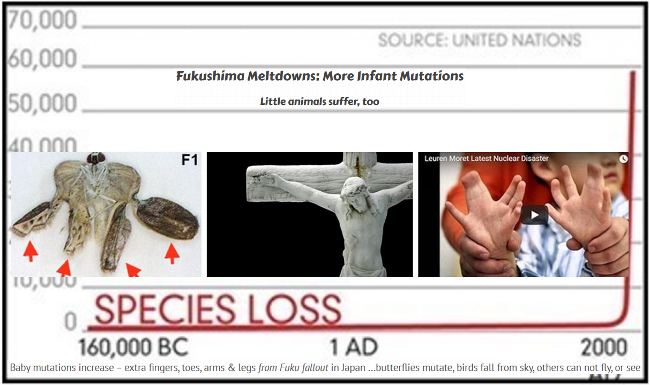


 Hair loss , baldness and lesions
 Hair loss, baldness, lesions